

Hoima City Stadium
An overview of Hoima City Stadium
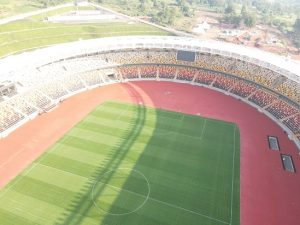
Hoima City’s skyline is about to be redefined. The grand UGX 450 billion (USD 130 million) Hoima City Stadium—Uganda’s newest sporting jewel—is now 95% complete and on track for full completion before the end of the year. The world-class facility will play a starring role in the 2027 Africa Cup of Nations (AFCON), co-hosted by Uganda, Kenya, and Tanzania.
Rising from Mparo Division in Hoima City, the stadium gleams in the vibrant colors of Uganda’s flag, a striking testament to ambition and national pride. Constructed by Turkish firm Summa International using funds from Uganda’s Petroleum Fund, the stadium signals that the country’s oil wealth is already scoring its first dividends—well before the first drop is refined.
A Strategic Investment
Built on 42 acres, the 20,000-seater arena—complete with a 1,000-seat VIP section and accessible areas for people with disabilities—will be Uganda’s second AFCON-certified stadium after Mandela National Stadium, Namboole. Its proximity to Kabalega International Airport positions it as a key anchor in the region’s growing sports and economic ecosystem.
But the question on everyone’s mind is whether this multi-billion-shilling masterpiece can avoid the “white elephant” fate that has haunted stadiums across Africa. Facilities in Angola, Gabon, and Mali now stand as costly monuments to underuse.
Sustainability undertones
Ambrose Tashobya, Chairperson of the National Council of Sports (NCS) and Head of Infrastructure for AFCON 2027, insists Hoima City Stadium was built with sustainability at its core.
“It’s a multi-use, multi-sport facility. Beyond football, it includes a track for athletics, a rugby pitch, a modern gym, and a swimming pool for athlete recovery,” he explained during a recent media tour. He was accompanied by Murat Altun, the Project Manager for Summa.
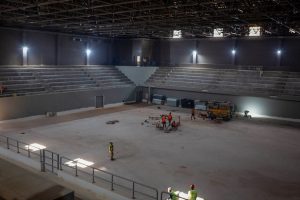
An adjoining indoor arena will host up to 2,080 spectators and accommodate volleyball, basketball, boxing, badminton, table tennis, and other sports.
“It is a high performance centre in the sense that an athlete can train, do strength and conditioning in the modern gym and go swimming for recovery,” he said.
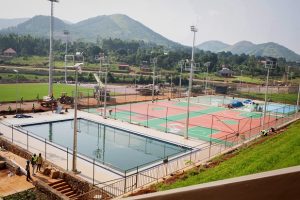
The facility also boasts a spacious cafeteria for 300 people—the largest in Hoima—and a parking lot for over 1,000 vehicles.
“The public can use these amenities, from the gym to outdoor facilities like swimming pool, basketball and volleyball courts,” said Tashobya, noting that the complex can host both national and international competitions. The growing corporate presence in Hoima, driven by oil-related investments, is expected to fuel steady demand for events, sponsorships, and leisure activities.
More than a stadium
According to Summa’s Altun, the stadium’s design prioritizes commercial viability. “We’ve built three levels of hospitality spaces, with food and beverage sections on each level. There are 10 concession units for general spectators, 12 VIP suites—including a presidential suite—and family-friendly private lounges,” he explained.
In addition, over 2,000 square meters have been reserved for leasable commercial space—ideal for banks, shops, and corporate offices. “You’re not going to host games every day,” Altun said. “These areas will generate revenue and help ensure the facility’s long-term sustainability.”
A future beyond AFCON
While the stadium lacks on-site accommodation due to limited land, the President has directed private investors to develop hotels in preparation for AFCON 2027, promising a ripple effect in tourism, hospitality, and transport sectors.
Tashobya confirmed that the National Council of Sports will oversee the facility’s management, guided by a forthcoming national policy that could open doors for private operators.
“The policy will inform us whether we shall get a private entity to manage it or we will do it ourselves,” he told Business Focus.
Though operational budgets and projected revenues are still being finalized, optimism remains high. If well-managed, Hoima City Stadium could emerge as a benchmark for how sports infrastructure can fuel regional economies, nurture talent, and redefine urban landscapes.

Uganda’s newest colossus has everything it needs to thrive beyond the final whistle—vision, design, and commercial foresight. Whether it survives the dreaded “white elephant” curse will ultimately depend on one factor: management that treats this arena not as a monument, but as a living, breathing business.