

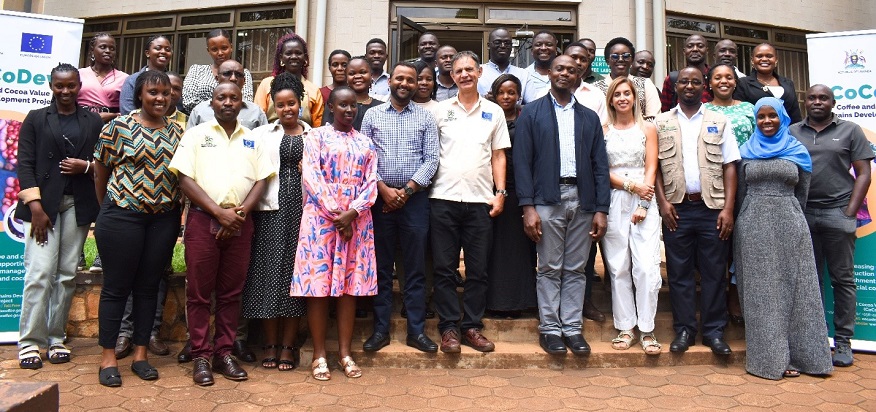
Participants that attended the cocoa sensory profiling workshop at the Coffee Department lab in Lugogo
Participants that attended the cocoa sensory profiling workshop at the Coffee Department lab in Lugogo
Experts have warned that poor fermentation methods and post-harvest handling practices in the cocoa sub sector risk Uganda’s reputation and competitiveness in the global cocoa and chocolate market valued at USD 46.6 billion.
Despite Uganda’s potential to be among the top producers of specialty cocoa beans – that are much sought after by top chocolatiers around the world – our raw beans lack the right quality due to poor post-harvest handling practices.
Mr. Alastair Taylor, the Chief Technical Advisor, of the Government of Uganda, European Union support “Coffee and Cocoa Value Chains Development Project” (CoCoDev), which is situated within the Coffee Department, Ministry of Agriculture, Animal Industry and Fisheries (MAAIF), recognized the impact poor agronomy and post-harvest handling practices could have on the sector, noting that;
“There is a lack of knowledge in the value chain. While there is a surge in planting, there are knowledge gaps from the harvesting point onwards. The post-harvest handling, fermentation – which is critical for cocoa bound for the chocolate industry – and the actual marketing, are still lacking,”.
In a bid to bridge this knowledge gap, the CoCoDev project organized a 4-day cocoa sensory profiling workshop at the MAAIF coffee laboratory at Lugogo. The training targeted quality assurance officers from the MAAIF Coffee Department, the National Coffee Research Institute (NaCORI) and selected private practitioners working within the cocoa value chain. A total of 40 Trainer of Trainers (ToTs) were trained and will share their knowledge with other value chain actors.
Mr. Francis Nuwagira, the Project Officer CoCoDev noted that the training is part of result area 3 which aims at developing standard cocoa profiling and characterization tools to brand and market Ugandan cocoa. One wider output, beyond the training was the start of developing a sensory flavor profile of Uganda cocoa to highlight its unique attributes.

CoCoDev hired a consultant to carry out a countrywide study and document cocoa flavor profiles in the main Cocoa producing districts/regions, develop quality assessment tools for Uganda, and train industry experts how they can use the tools to evaluate cocoa, as is done in the coffee sub sector. This will help put Ugandan cocoa in the spotlight of the exquisite markets and guarantee full traceability of and sustainability for value chain actors from the farm to chocolate.
The lead consultant was Dr. Zoi Papalexandratou, a global cocoa expert specializing in post-harvest, fermentation and specialty markets to develop standard cocoa profiling and characterization tools for Uganda. She worked with a Ugandan Cocoa specialist, Mr Edrisa Sserunkuuma, who was responsible for collecting the cocoa samples from across Uganda.
Mr. Taylor noted; “As CoCoDev, we wanted to bring in international expertise to identify the different cocoa profiles we have around Uganda. We all know Bundibugyo for cocoa, maybe a bit of Mukono, but as planting of cocoa is spreading out to new districts, it is important to map the different flavor profiles we have in the country to support market access.”
Among the activities carried out by Zoi were the identification and documentation of cocoa profiling parameters, development of sensory and mapping assessment tools tailored for Uganda’s cocoa, and building capacity of government and non-government actors (ToTs) in applying the profiling tools.
As part of the exercise, Zoi and her team carried out field work to identify current farming practices in the Eastern, Western and West Nile regions of Uganda and how they impact cocoa quality.
Sensory attributes of Uganda cocoa
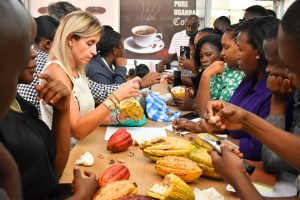
The researchers picked samples of fresh cocoa beans from different districts and demonstrated that sensory assessment begins from tastes and smells as soon as the fresh pods are cracked open. Samples of the best fermented dried cocoa beans were collected by the consultants to develop a representative selection of cocoa profiles from the different regions in Uganda.
The consultant used this data to develop a cocoa flavor map for Uganda showing the sensory potential for well fermented/dried cocoa. The map revealed the unique flavor profile of each cocoa growing region.
In Eastern, the flavor map showed that cocoa beans from Kamuli had a sensory profile of apple, maple, herbal/tobacco, mango and tamarind. In Mayuge, well fermented cocoa beans had a complex profile with attributes of fruity berry, yoghurt, melon, savory, dough/biscuit, unami, and floral notes. Other districts profiled in the East were Iganga, Bugiri and Mayuge.
In South Western, cocoa was sampled in Mityana, Kabarole, Kasese, Rubirizi, Kanungu, Mpigi and Rakai and profiles developed. In Central and North West, the districts profiled included Kyotera, Masaka, Mukono, Kagadi, Hoima, Koboko, Bundibugyo and Kyenjojo.
The study showed that the potential of Uganda to produce quality beans is high due to the rich genetic diversity of the cocoa growing in the country. This is enhanced by the “terroir” (complete natural environment) which includes Uganda’s rich soils, good climate, altitude and organic farming practices.
Poor practices limit potential
According to the experts, while this is the potential of well fermented beans from Uganda is high, this is not the quality that is actually exported.
Sserunkuma Edrisa, a cocoa expert with over 15 years in industry and works with Zoi, noted that value chain actors need to work towards having a good product to reach the specialty market.
“We have a lot of potential, but the industry is not organized. Everyone is doing things the way they want. Farmers are doing wrong practices in agronomy. Some don’t want to prune; whilst others will prune, but they are doing it the wrong way. Some don’t know how to ferment. When they are fermenting, they use means that are not really acceptable. They don’t bring out the real organoleptic potential of the cocoa beans.”
“The beauty of well fermented Ugandan cocoa is that it scores 90, and above, in organoleptic assessment, which considers the colour, flavor, fissuring, smell and diversity of the cocoa beans. If we can correct the mistakes we are making at the moment, and implement very good post-harvest handling, Uganda can be one of the best specialty origins in the world for cocoa, even competing with Latin America and elsewhere,” Mr. Sserunkuma noted.
He warns that, although currently Ugandan cocoa is among the most expensive at farmgate in the world, things could change. Farmers need to improve their practices and quality through better agronomy and fermentation of cocoa, to ensure continuing good prices.
“Since most farmers are getting a very good farmgate price, they don’t see the importance to ferment their beans. If practices don’t change, prices will fall and Uganda will lose out on the market share,” he concluded.
Need to segment the cocoa market
Zoi called on government to equip farmers with the right knowledge and skills which will support the shift from exporting conventional cocoa, to the targeting specialty markets.
Currently Uganda exports 98% of the cocoa beans, without market segmentation. Even the good quality beans are sold as conventional, which means that farmers miss out on premiums because they don’t know how to ferment to get the right quality.
“Right now, there is hardly any segmentation. 95% of the cocoa that goes out of Uganda is conventional. Once we have more farmers trained, and knowing what practices are the right ones for the right product, we can start creating the segmentation for the market. This is healthier and more sustainable for the long term,” she added.
She adds that this will help farmers get premiums for the better cocoa qualities. It will also build the reputation of Uganda as a supplier of quality cocoa. Currently the information people have about Uganda’s cocoa is very scattered, or it is based on just on few private initiatives, which are usually coming from foreign investments.
Zoi also warned that the growing cocoa exports face risk of climate change and poor practices in post-harvest and fermentation. She recommended training value chain actors on quality standards and market positioning, should be a priority for Government and other sector support services.
Turning around the fortunes of cocoa
Since coca prices went up, the demand for cocoa seedlings has gone up. With growing demand for planting materials, there are deliberate efforts being undertaken by government, with support from CoCoDev, to facilitate research into development of new, and high yielding, cocoa varieties.
Job Chemutai, a research scientist working at the National Coffee Research Institute (NaCORI) says that CoCoDev is supporting the Institute to develop new cocoa varieties that are rich in flavor and are high yielding.
Cocoa is becoming a prominent crop, with export volumes and income increasing. Therefore, there is a lot interest and demand from the public.
“Export earnings from cocoa have moved from about USD 7 million about 20 years ago, to right now about USD 600 million in 2025. So, the potential is really high. But we now need to improve the quality of the cocoa produced in the country. NaCORI is glad to partner with CoCoDev, through the funding from the EU, to have these initiatives which will help us to improve on the quality.”
Chemutai believes the training conducted by CoCoDev pushes cocoa professionals and the industry forward.
“This helps us to address the quality aspects, and meet the parameters like fermentation of cocoa, to improve the quality. The training also offers an opportunity to be able to develop manuals that will help us in doing quality assessments, both at the primary level, that’s at the farm level, and also at the processing level,” he noted.
According to Chemutai, initiatives by CoCoDev also build on the country’s efforts towards agro-industrialization.
“We are looking at improving on the value of our cocoa produced in Uganda, so that we can produce various products like chocolate, cocoa butter, and cocoa powder.”



I like the article. Am a new cocoa farmer with 1,200 3 months old plants. Willing to learn from experts and experienced farmers for high and quality cocoa harvests.