
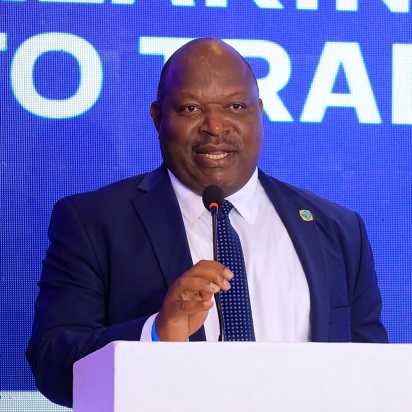
Richard Byarugaba, the Executive Director for Finance at BoU
Richard Byarugaba, the Executive Director for Finance at BoU
The Bank of Uganda (BoU) has revealed that financial institutions have cumulatively disbursed Shs1.23 trillion under the Agricultural Credit Facility (ACF) since 2009.
The revelation was made by Richard Byarugaba, the Executive Director for Finance at BoU while representing the Deputy Governor at The Global Influence Club on the topic ‘Breaking Barriers to Trade’ for women entrepreneurs held at Sheraton Kampala Hotel on Tuesday, 29th July 2025.
The interest rate on loans extended under the scheme is capped at 12% per annum.
“As at the end of June 2025, the ACF had cumulatively disbursed UGX 1.23 trillion, benefiting 7,666 recipients across the country,” Byarugaba said, adding: “These funds have supported the acquisition of agricultural machinery and equipment for mechanisation, post-harvest handling, and irrigation to promote climate-smart agriculture, as well as access to inputs, improved breeds for increased yields, and agro-processing activities.”
He added that the ACF maintains strong financial health, with a non-performing loan (NPL) rate of just 0.5% of the total government contribution disbursed as at 30 June 2025.
“This is significantly lower than the average NPL for the agriculture sector, which stands at 3.9% – indicating strong performance,” he said, adding that the ACF provides financing to entities involved in agro-processing and grain trade to expand market access.
On the topic of the day, Byarugaba said trade between nations fosters specialisation, which allows for efficient resource allocation and provides access to a wider variety of consumer goods and services.
“Generally, the world is better off when countries import products that are produced more efficiently and cheaply by others. Trade is, therefore, a powerful engine for economic development and a force for positive change,” he said.
He noted that the Bank of Uganda and financial institutions play a crucial role in promoting trade.
“We facilitate international trade by ensuring exchange rate and financial sector stability, which are important for competitiveness and for attracting private capital inflows for investment. In practice, the BoU uses monetary policy to ensure price stability, and in particular, exchange rate stability. This implies that the Bank plays a vital role, through its policies and payment systems, in ensuring that trade operates smoothly,” Byarugaba said.
However, he said, there are challenges to trade, as some businesses are adversely affected by competition.
“At the international level, the hindrances to trade include, among others: rising geopolitical and trade tensions, as witnessed between the US and its trading partners; complex customs regulations; limited human resource capacity; high input costs; limited access to affordable financing; and competition from substandard goods. In addition, structural impediments, such as inadequate transport and communications infrastructure, can act as barriers to trade flows.”
He noted that these challenges are more pronounced for vulnerable groups, including women, youth, and informal workers, due to factors such as limited access to resources and exploitation.
“Women traders, for instance, may face discrimination, harassment, and violence because of cultural practices and social norms that tend to limit their participation in economic activities. These challenges are further compounded by the impact of climate change — such as droughts and floods – on economic activities. Climate shocks and related natural disasters disproportionately affect vulnerable households and businesses, especially those engaged in agriculture, thereby limiting their participation in trade,” he said.
To break barriers to trade, he said a number of measures have to be undertaken.
“First, there is a need to promote inclusive trade policies that protect vulnerable groups, such as women, youth, small and medium-sized enterprises (SMEs), and smallholder farmers,” he said, adding: “Second, increase access to information on trade opportunities and affordable finance schemes that can empower vulnerable groups to participate more effectively in production and trade. Relatedly, there is a need for skills training, which can help improve productivity and competitiveness.”
He added that there’s also need to invest in climate-smart and sustainable agricultural practices.
“These encompass innovations that will assist vulnerable communities in building resilience to the impacts of climate shocks on their production and trade,” he said, adding: “Fourth, strengthen regional integration and trade to expand markets for goods and services. Such regional integration initiatives should be supported by improvements in transport, communication, and energy infrastructure, which are crucial for enhancing production and reducing the cost of trade.”