
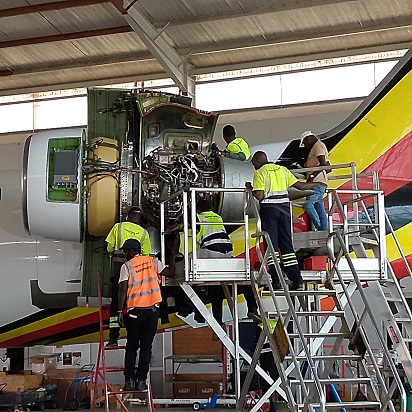
Engineers putting final touches on the installation of the new aircraft engine
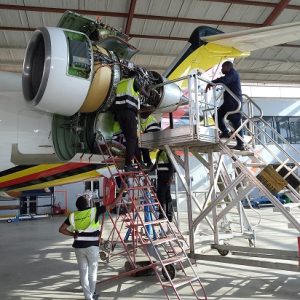
Uganda Airlines’ Approved Maintenance Organisation (AMO) has achieved a major milestone this week by successfully completing its first in-house engine change on one of the airline’s CRJ900 aircraft, registered as 5X-KNP. This aircraft is among the initial four that Uganda Airlines first acquired.
AMO is the dedicated aircraft maintenance division of Uganda Airlines. Approved by the Uganda Civil Aviation Authority (UCAA), it provides line maintenance services for the airline’s CRJ900 fleet and is steadily building its capacity to become a leading maintenance provider in the region.
This achievement comes as Uganda Airlines prepares to mark its 6th Anniversary on August 28, 2025.

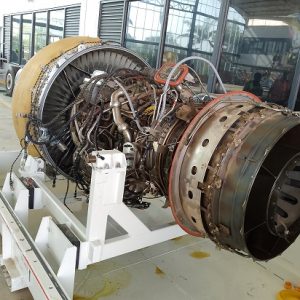
An engine change involves carefully removing an existing engine and installing a replacement. The CRJ900 is powered by two General Electric CF34-8C5 engines, designated as Engine 1 (left) and Engine 2 (right). According to Peter Aisu Emuge, Head of Maintenance & Engineering at Uganda Airlines, the operation was conducted on the Number 1 engine.
Emuge told reporters at AMO headquarters in Entebbe on August 22 that the replacement engine, which costs USD 7 million, was sourced from the United States. The change was necessary to facilitate a scheduled manufacturer modification on the previously installed engine. He noted that such changes are typically carried out after 12,000 flight cycles—referring to the number of routes an aircraft has flown—and are a standard practice across the airline industry.
The removed engine will be shipped back to the manufacturer for upgrades and will later be re-installed in the Number 2 position, allowing that engine to undergo the same modification.
While engine changes are routine in aviation, this particular event was significant because it marked the very first engine replacement performed entirely in-house by the Uganda Airlines AMO team since receiving its UCAA approval in March 2024.
“It is a sense of pride that we can now carry out maintenance ourselves,” said Joseph Lukwago, AMO Project Manager.
Both Lukwago and Emuge emphasized that this achievement has saved the airline substantial costs by avoiding outsourcing. For instance, conducting the change abroad—in South Africa, USA or elsewhere—would have cost the airline more than USD 10,000 in fuel and over USD 100,000 in maintenance charges among other costs.
“Uganda Airlines used to spend between UGX 800 million -Ugx1 billion on maintenance before…” Lukwago noted.
The process of changing an engine requires high-level technical expertise. It involves disconnecting the engine from its mounts, transferring components from the old engine to the new one (collectively known as the Quick Engine Change kit), and meticulously reconnecting an intricate network of hoses, pipes, and electrical systems. The new engine is then hoisted into place and securely mounted on the aircraft.
This accomplishment demonstrates the growing capacity of Uganda Airlines AMO, which is staffed by highly experienced engineers, some of whom have been internationally recruited.
Beyond immediate operations, the AMO is also investing in the future of Uganda’s aviation sector through training programs. Currently, 18 graduate trainees from institutions such as Soroti Flying School and universities offering Mechanical and Electrical Engineering are undergoing hands-on mentorship. These trainees are enrolled in a structured program aimed at preparing them for aircraft maintenance licensing within three years.
At present, the AMO employs 45 staff members. The engineers who worked on the engine change received training in Uganda, Kenya, and Ethiopia.
Looking ahead, Uganda Airlines CEO, Jenifer Bamuturaki, revealed that the airline has ambitious plans to expand its maintenance capabilities by establishing hangars and workshops to provide full base maintenance services. The long-term goal is to offer maintenance support for third-party aircraft, creating new revenue streams to help offset the airline’s current losses.
Base Maintenance will encompass specialized workshops including: Wheel Shop, Hydraulic Components Shop, Pneumatic Shop, Radio Shop, Instruments Shop, Electrical Shop, Airframe Overhaul Shop, Battery Shop, and Composites Shop.
“What we are witnessing today is a big milestone for Uganda Airlines,” Bamuturaki said.
She emphasized that previously, the airline had to fly aircraft abroad for such maintenance tasks—something that has even been done with the Airbus. She praised her team for their dedication and noted that Uganda Airlines is now opening opportunities to homegrown Ugandan talent trained both locally and internationally.
“Some of our neighbors have their aircraft grounded, but because we planned ahead, we are able to carry out this work. This engine change also proves that my team and I, with government support, are doing a great job for Uganda Airlines,” Bamuturaki said.
She concluded with a message to customers: “I would like to assure our passengers that we are ready to serve you with the best service you deserve at Uganda Airlines.”