

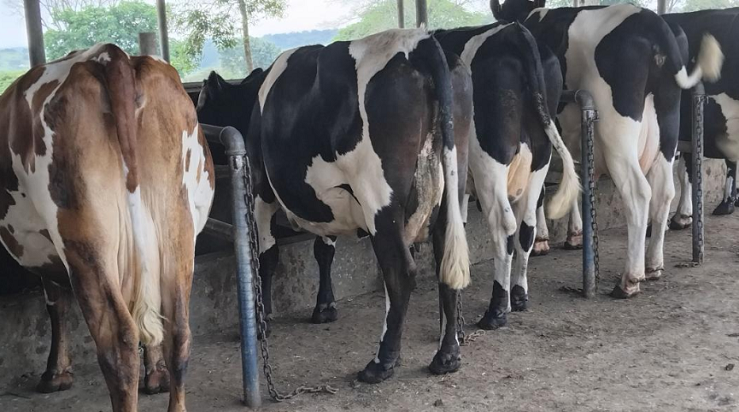
The loan will mainly benefit small livestock farmers in the cattle corridor
Parliament has asked the Ministry of Agriculture, Animal Industry and Fisheries (MAAIF) to renegotiate the US$204.8Million (UGX 717.195Bn) loan meant to boost cattle production in Uganda.
This is after it was discovered that the Ministry had planned to spend over UGX15.648Bn on paying consultants, UGX14.402Bn on trainings and workshops and UGX9.791Bn to purchase vehicles, yet some items meant for the main implementation of the project have received less allocations.
The recommendation was made by John Bosco Ikojo, Chairperson, Parliament’s National Economy Committee while presenting the report on the proposal by Government to borrow up to US$99.56Million from the International Fund for Agricultural Development (IFAD) to finance the proposed Resilient Livestock Value Chain (RELIV) Project during yesterday’s plenary sitting.
“The Committee observed that the project cost is US$204.8 million, (UGX 717.195Bn) however the cost breakdown and outputs described under the project loan were not costed to facilitate oversight of the unit cost of the various outputs that will be financed under the project. In addition, the Committee notes that part of the IFAD Loan proceeds will be used to acquire Vehicles US$2.796 Million (UGX9,791,657,700), Consultancies US$4.464 Million (UGX15,648,445,000), Training and Workshops US$4.111Million (UGX14,402,657,000). In addition, the loan should be renegotiated to move resources from consumptive items to acquisition of goods services and inputs, as well as equipment and materials,” Ikojo said.
Ikojo further informed Parliament that despite the Committee requesting officials from the Ministry of Agriculture to share the costed outputs under the project components to facilitate oversight of the unit costs, by the time this report was prepared, this information had not yet been received.
“The Committee is concerned that these are consumptive items taking up a substantial amount of the loan proceeds. A case in point is the project plans to acquire fifteen Vehicles which translates to a unit cost of a Vehicle at UGX671Million. The Committee recommends that given the constraint where Government needs to sign the loan by 12th September 2025, and the opportunity cost of Government of signing the loan in time is high, the MAAIF finds time to discuss the costed outputs of the project even after the IFAD financing is considered,” added Ikojo.
While presenting the Committee’s report, Ikojo also protested the rushed manner in which the loan request was considered, noting that although the Rules of Procedure of Parliament require Parliament to scrutunize the loan request within 45days, the Committee only had four days to consider the loan, owing to the need by Government to sign the loan by 12th September 2025, or risk losing out the deal to the lender.
He noted, “The rules of procedure of Parliament stipulate that business referred before any Committee will be considered within 45 days. However, of recent we have noted a surge in loan requests being submitted to Parliament at a tail end of their loan approval dates. The Committee had four working days to consider the loan request. This makes it very difficult for the Committee to scrutinize the loan request and report to the house adequately. The Committee notes that the proposed financing terms of IFAD are highly concessional with long maturing and grace periods. Of recent, Government has not been having access to such concessional loans, with most recent loan requests sought on either semi concessional or commercial terms less than 30 years of maturity and grace period at most five years.”
Despite these glaring loopholes, the Committee on National Economy recommended to Parliament for the approval of the loan, something that didn’t sit well with some Opposition MPs like Ibrahim Ssemujju (Kira Municipality) who asked MPs not to hang themselves by approving such a controversial loan.
Ssemujju noted, “The chair of the committee has raised the fundamental issues. First issue is that they did not have adequate time to scrutinise this loan request and therefore advised Parliament adequately. That is in his report. Then he says you have nearly US$3Million to buy 15 vehicles. They were unable to look at the detailed cost component and then the chair of the committee while presenting the report of the committee the committee report says go and renegotiate this loan request. I don’t know what’s wrong with colleagues that you can say all the things that you have said and then you say you want the loan approved.”
He urged fellow lawmakers not to fall victims to the mistakes made in the past where Parliament approved loans and the President stopped the processing of these loans, a decision he said made Parliament look ridiculous before the public.
“That is why I am saying with the proposals that the committee has made, they have left us with no option but to say no to this loan request. I think they are only polite not to make government look bad that after informing you of all the problems associated with the request, then they say it is up to you to hang yourself and I am asking this Parliament, please don’t accept to hang yourself. They have said the most fundamental issues, they must renegotiate the terms of this loan request. Now, if you approve, what will you be approving?” added Ssemujju.
Muwanga Kivumbi (Butambala County) protested the US$8Million (UGX28,010,886,000) that has been set aside for the management of the loan, which he said is worsened by the fact that the core activities of the projects have less funding allocations as opposed to the consumptive items.
He noted, “I have seen here, US$8Million is going to go towards management. At the core of our report, is that most projects you have looked at don’t place money where it is adequately needed. It goes to components where it is easy to eat the money, through consultancy, through management. This looks like a classical failed project that is intended to benefit only the elite, not the real farmers. And I’m not convinced now that this committee has adequately had time to look at this project.”
However, the Minister of State for Finance, Henry Musasizi defended the loan proposal arguing that it is one of the best loans Uganda has had in a long time with low interest rate and long repayment period of 50years and an additional grace period of 10years.
“It is true this loan has strict timelines. We must sign off by 12th or else we lose the money and also all other programmed borrowing under IFAD. I would like to allay Ssemujju’s fears is that this loan has got the best terms. The terms are very okay and it is highly concessional whereby under category A and B the interest rate is zero. So, you can imagine a loan which we are getting for zero interest rate. So, there is no interest we are going to charge and the repayment period is 50 years, you can imagine with a grace period of 10 years. So, this is the best arrangement you can have.”
According to the Ministry of Agriculture, the project is intended to contribute to the improved livelihoods of smallholder livestock producers in Uganda and also to enhance income, nutrition and resilience of smallholder dairy and beef producer.
Government also defended the need to invest in Uganda’s livestock sector owing to its 21% contribution to agricultural added value in Uganda and 4.3% of national Gross Domestic Product (GDP), with cattle being by far the most important species with 14.2 million heads, and 1.4 million households keeping cattle, which contribute from 12 to 75% to their total income.
The Ministry also informed the Committee that Uganda’s per capita consumption of beef and cow milk is 6kg and 36 litres per year, respectively, which is still low compared to other countries in the region. However, the Food and Agriculture Organisation (FAO) estimates that demand for beef and milk in the country will increase by 320% and 200% by 2050 respectively due to ongoing population growth. Total meat and milk production is valued at US$8.7 million per year (UBOS, 2017).
The project will target 400,000 households (2milliom persons), comprising of smallholder dairy and beef farmers engaged in intensive and semi-intensive small-scale integrated production systems, as well as small and medium scale extensive agro-pastoral systems.
The other direct beneficiaries will be private service providers engaged in AI, veterinary services, feed and fodder seeds production, mechanisation, with a specific focus on youth; small scale processors, including individuals, groups women and youth groups; and public institutions involved in delivery of livestock related services (research, extension, regulation and control, policy formulation, animal health and breeding services), and their staff.
According to the Project appraisal document, at least 40 percent of the beneficiaries will be women and 25 percent will be youths. The project will be implemented in 55 selected districts in the cattle corridor of the country and the districts were selected based on the following: High incidence and density of poverty, food insecurity and malnutrition; Herd size by the households and potential for dairy and meat (beef) value chain development, including markets for animal sourced products; High potential for women and youth to get involved in dairy and beef value chain; and Climate vulnerability
Greetings from Bunyama multipurpose organisation Uganda,
We are doing projects that transforms our communities into self-reliant citizens via empowerment projects focused on modern agricultural practices, fish farming, Horticulture, Bee keeping and other poverty alleviation activities in relation thereof.