
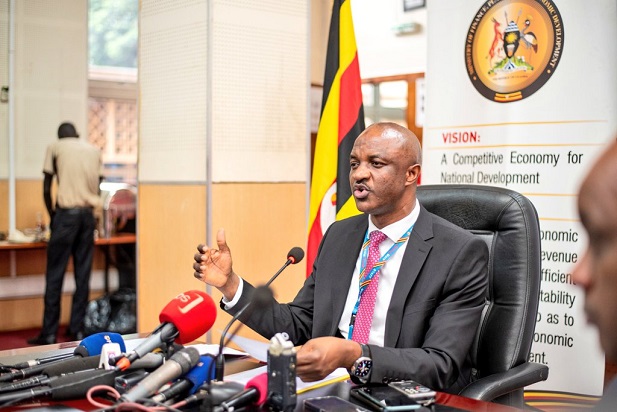
Secretary to Treasury, Ramathan Ggoobi
Uganda’s Ministry of Finance, Planning and Economic Development has revealed that out of the 66 externally funded projects executed by Government, 55 projects are behind schedule, while 5 projects are on track and only 6 projects have been completed, prompting several experts to call on Government to increase on its oversight during the implementation of public projects.
The details are contained in the Performance of Externally Funded Projects report, that covered the period December 2024 to May 2025 that was released by the Ministry last week, indicating that overall, 17% of the projects showed good implementation, recording either completion or on track status yet on the other hand, 83% of the projects were behind schedule.
“Of the 55 projects that were behind schedule, 10 (18%) had stagnated, while 41 (75%) showed slight improvement. The Integrated Transport Infrastructure and Services Programme accounted for 60% of the stagnated projects. The most common challenges faced by project implementers were delayed procurements, and acquisition of right of way (RoW). These were followed by delayed approvals for new loans, reallocation of funds in cases of rescoping, as well as requests for additional funding,” the report reads in part.
Secretary to Treasury, Ramathan Ggoobi urged the responsible accounting officers to study the report and implement recommendations to improve the performance of these projects, noting that the renewal of their contracts will be hinged on performance of projects under their watch.
“The report shows improvements as more projects were completed, while half of those that had stagnated in the previous review period picked up significantly. The resources noted for stagnation are the usual challenges that Accounting Officers can effecti9vely deal with. This is to urge all concerned Accounting Officers to critically review this report with a view to instituting effective mechanisms for tackling the identified bottlenecks. As we journey towards the exponential growth of the economy, performance of projects will continue to be a performance measure for renewal of contracts for Accounting Officers,” noted Ggoobi.
According to the breakdown provided, of the 11 programmes with externally funded projects, five (45%) had all their projects behind schedule and this was most prevalent in the Natural Resources, Environment, Climate Change, and Land and Water Management Programme, that had 10 projects behind schedule.
Among the programmes with poor performance included Integrated Transport Infrastructure and Services that has 21 projects but of these, 18 are behind schedule, with only one project on track and 2projects were completed. The Human Capital Development project comes next with 14 projects under execution but of these, 12 are behind schedule, while Natural Resources programme implementing is implementing 10 projects with all of them being behind schedule.
Dr. Isaac Shinyekwa, Head of Trade and Regional Integration Department at the Economic Policy Research Centre (EPRC) urged Parliament to put in place indicators that will guide the institution on scrutiny of these projects given its crucial role in approval of funds for these externally funded projects.
He explained, “Parliament should strengthen indicators for approval and unapproval. Sometimes in Parliament, when some of these conversations come up about approval of projects, people draw their allegiances from their political party sometimes instead of typical indicators that will tell whether we are ready to have that money coming or not. And I think that’s why I fault Parliament. They should develop a set of indicators, which if not fulfilled, then the money is not approved.”
Among the indicators that the Economic Research Policy Centre wants Parliament to put in place include presence of counterpart funding, feasibility studies, shorten procurement process, qualifications of human resource executing the projects and ensure that land on which the projects will be executed is available before funds are approved.
“Sometimes the money comes and then they have to go start doing feasibility studies. So, do you expect such a project to complete on time? So that’s another area of an indicator to look at. Let us look at our procurement processes, sometimes they are also too lengthy. For example, if you go through a process and none qualifies, then you start afresh. You know what that means, that means you are delaying. Do we have expertise, local expertise in project planning and management on those particular projects? If not, are we going to raise them from out?” added Dr. Shinyekwa.
Timothy Chemonges, Executive Director, Centre for Policy Analysis describe the findings in the report by the Ministry of Finance that 83% projects are behind schedule as very worrying because this means that critical Government services like roads, schools, hospitals are limited won’t be accessible to many Ugandans yet it is the same people paying interests on these loans, saying the delays are an addition to the national debt without giving the people the services they desperately need, thus leads to erosion of trust in Government.
“And to fix this, Government must strengthen oversight and project management so that every project is tracked and people are held accountable for delays because this touches to the role of Parliament in ensuring that work is done according to plan. We need to deal decisively with corruption and political interference that often hinder project implementation. There is also timely borrowing to clear results so that the loan directly improves livelihoods on the ground. For many times, we have seen that Government brings to Parliament loans and sometimes, there are no clear plans in terms of how they should be done and that means that the project started from the wrong start,” said Chemonges.
Former Leader of Opposition, Winnie Kiiza argued that the performance of17% means Ugandans shall continue paying the loans without necessarily getting the service for which the money borrowed for which explains why in the recent national budgets, there is a huge percentage of the budget dedicated to servicing loans, which means that Ugandan taxpayers are paying interest on loans without necessarily benefitting from these loans.
She noted, “You know, the unfortunate bit is that as a country, I think we don’t even know what we want. Sometimes we go for loans and we get the money, we don’t use it for the reason for which we requested for the loan. Parliament is supposed to continue following up on how we use the loans, but you acquire a loan, four years down the road, you have gotten the money but you have not used it for the purpose for which you asked for it, by the time you start implementing the project, money has lost value and then they will start telling you, we need more money.”
Kiiza added, “So by the time we are implementing the project, money has lost value. People have abused the processes and we are paying for hot air; we are paying for nothing. Ugandans continue to service the loans for whose services they have not attained. So, the moment parliament closes its eyes and ears to the waste in government, everything that is to do with service delivery collapses.”
MPs React to Report Findings
Robert Migadde (Buvuma Island) and also Vice Chairperson, Parliament’s Committee on National Economy admitted that Ugandans are paying high commitment fees on idle loans and that some projects are having cost overruns because of delays, but he also argued that the Committee’s recommendations on some of the conditions Government has to fulfil before loans are considered are at times ignored especially the failure by Government to have feasibility studies completed, designs and acquire land.
He remarked, “Many times we have been noting the issue of feasibility studies where loan requests come, at times even before feasibility studies have been undertaken, and at times where the environmental impact assessment has not yet been done, so where even the money for that is also coming from the loan. And many times we have recommended that the agencies should come to parliament when they have already undertaken feasibility studies, and if there are roads, we recommend that, for example, during a time of UNRA, that they should come to parliament after having in-house road designs, so that they are coming for implementation, because designing may take a year or two.”
Migadde also attributed the delayed execution of projects on the late disbursement of funds by the lenders arguing that some funders take over two years to disburse the funds noting, “From the time we approve as parliament, it takes almost two years for the World Bank or the other agencies to make final approval, so you have lost two years there. But the ordinary person starts counting from the day the loan is actually approved.”
Nathan Byanyima (Bukanga North) also member of National Economy Committee while reacting to the report findings noted, “The performance is not very promising because we have secured quite a number of loans from good donors, some of them are very good concessions and some are grants. But the way the implementation is at a low pace and we feel that our honourable ministers and technical staff, they should pull up to show that actually money is utilised and the projects get the beneficiaries and users, our people.”
The Ministry of Finance defended the need to conduct assessment on performance of projects noting that over the years, the Ministry of Finance, has mobilised resources for projects, however, there is a problem of poor implementation of the projects, which prompted Cabinet in 2023 to request performance assessment of externally funded projects.
The assessment is conducted by the Budget Monitoring and Accountability Unit (BMAU). In September 2024, the first comprehensive report on the performance of externally funded projects was produced. This was to be followed by semi-annual assessment reports on these projects. This report is a follow-on and it shows what has changed since December 2024.