
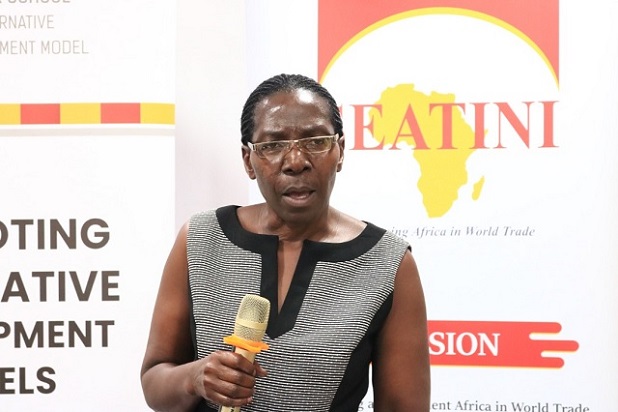
Jane Nalunga, Executive Director of SEATINI-Uganda
Jane Nalunga, Executive Director of SEATINI-Uganda
As the 14th World Trade Organisation (WTO) Ministerial Conference approaches next month in Cameroon, Ugandan civil society leaders are urging African governments to speak with one voice in defending the continent’s trade interests.
At a consultative meeting in Entebbe, Jane Nalunga, Executive Director of SEATINI-Uganda, emphasized that African countries must first address internal challenges before looking outward.
“Why is it still so difficult to travel between African countries, or from Africa to Europe?” Nalunga asked, highlighting the barriers that hinder trade and mobility across the continent.
She stressed the need for stronger collaboration among civil society, policymakers, and other stakeholders to coordinate efforts for sustainable trade growth.
Global Context and Rising Tensions.
Ministers from around the world will meet in Cameroon to discuss the future of the multilateral trading system.
The conference comes amid global uncertainties, from the Russia-Ukraine conflict and Middle East tensions to the US-Iran standoff and rising US-China friction.
These geopolitical crises are compounded by the United States’ imposition of unprecedented tariffs on multiple economies, forcing countries, including developing nations like Uganda, to re-evaluate trade and economic strategies.
Travel restrictions, particularly US business and tourist visas, are also exacerbating the impact on African economies.
Professor Emeritus Jane Kelsey, University of Auckland, New Zealand, explains that US actions are creating ripple effects globally. “Other regions, particularly the EU, are adopting protectionist measures, which affect developing economies worldwide. Several non-US powers are using this crisis to push WTO reforms, including weakening consensus-based decision-making and expanding plurilateral agreements.”
The US and WTO Under Pressure.
Since 2019, the US has sought to undermine the WTO, blocking appointments to the Appellate Body, imposing unilateral tariffs, and bypassing WTO rulings, actions that weaken the organization’s authority and limit options for developing countries.
Tetteh Hormeku-Ajei, Head of Programmes at Third World Network-Africa, says the fight to improve the WTO is increasingly becoming the responsibility of African nations. “We cannot compromise our positions to serve Western interests,” he urges.
Trade Deals and Long-Term Strategy.
While some countries have negotiated deals with the US to reduce the impact of tariffs, Vahini Naidu, Programme Coordinator, Trade for Development Programme (TDP), South Centre, warns that the deals often demand far more from other countries than they return.
“The tariffs are illegal tools designed to coerce compliance. Africa must adopt long-term, principled trade strategies rather than react under duress,” she says.
The upcoming WTO ministerial in Cameroon represents both a challenge and an opportunity. African countries and civil society must define priorities and strategies to safeguard trade interests in a system dominated by powerful global players, ensuring that Africa negotiates from strength rather than under pressure.
-URN
About the Author