
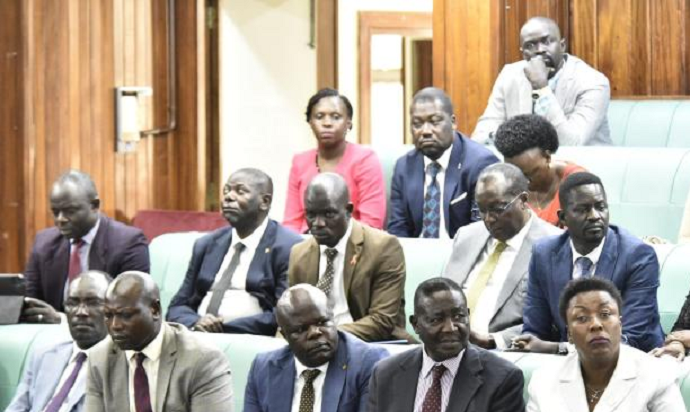
MPs inside Parliament's Chambers during the plenary sitting where some raised concerns of poor health infrastructure. Photo by Parliament.
MPs inside Parliament’s Chambers during the plenary sitting where some raised concerns of poor health infrastructure. Photo by Parliament.
Uganda has lost a staggering UGX 46.8 billion on terminal benefits for 1,389 staff reabsorbed into new roles, following a blatant disregard of legal guidance by heads of Ministries, Departments, and Agencies (MDAs), Auditor General Edward Akol has disclosed.
The revelation, detailed in Akol’s December 2025 annual report presented to Parliament last week, exposes deep weaknesses in the government’s Rationalisation of Government Agencies and Public Expenditure (RAPEX) initiative, designed to streamline Uganda’s bloated public sector.
“Despite clear directives from the Attorney General and the Ministry of Public Service under the RAPEX framework, these payments were made as if reappointments constituted new appointments,” Akol said. “This flouting of legal advice undermines fiscal discipline and erodes public trust in the rationalization process.”
Launched under Cabinet Minute No. 43 (CT 2021), RAPEX aimed to merge, mainstream, or dissolve redundant agencies, eliminate functional overlaps, and enhance efficiency. President Yoweri Museveni projected annual savings of up to UGX 1 trillion by reducing administrative costs.
The initiative targeted 157 entities, with plans to retain 61 as semi-autonomous, incorporate 33 into parent ministries, and rationalise the rest, potentially saving UGX 988 billion in duplicated costs.
By December 2025, 23 entities had been successfully rationalised, with 17 mainstreamed and six merged. However, Akol’s audit of eight agencies covering 1,917 staff revealed uneven implementation: 1,492 (78%) were absorbed into new structures, and 425 (22%) left in limbo, sparking disputes over unpaid benefits.
The unlawful payouts contravene the Employment Act, 2006 (Section 87(1)) and the Pensions Act (Chapter 281). The Attorney General had explicitly barred terminal benefits for reabsorbed staff, classifying such roles as continuity of service under RAPEX guidelines.
Yet, 1,389 staff received UGX 46.8 billion. Separately, 66 terminated staff received UGX 930.11 million instead of UGX 1.03 billion owed.
These violations also breach the Public Finance Management Act, 2015 (Sections 45 and 79), which holds Accounting Officers personally accountable for unauthorized expenditures.
Beyond salaries, the audit uncovered significant asset management gaps. Four entities reported UGX 564.71 million in mismatched assets, while three others showed UGX 54.44 billion in variances.
Physical inspections revealed encumbrances, encroachments, disputed parcels, and expired leases, exposing public property to potential losses. Akol urged stricter adherence to the PFMA, immediate verification of assets and liabilities, and prompt resolution of land disputes.
Several agencies have been rationalised under RAPEX, with functions merged, dissolved, or absorbed into parent ministries. Uganda National Roads Authority was dissolved, its functions taken over by Ministry of Works and Transport, while Uganda Road Fund, Uganda Warehouse Receipt System Authority, and National Children’s Authority were integrated into relevant ministries.
The Uganda Wildlife Education Centre (UWEC) merged with the Uganda Wildlife Authority (UWA), and the National Records and Archives Agency’s duties transferred to the Ministry of Public Service.
Similarly, the National NGO Bureau, National Meteorology Authority, and National Library of Uganda were incorporated into parent ministries, alongside sector-specific bodies like the Trypanosomiasis Control Council, NGO Board, and National Population Council. Even advisory councils for older persons, persons with disabilities, and children were absorbed into larger ministry structures.
The findings echo long-standing concerns over wasteful government spending voiced by Leader of the Opposition Joel Ssenyonyi. While unveiling the 2025/26 Alternative Budget, Ssenyonyi described corruption as “the biggest impediment to Uganda’s development,” noting billions lost annually through mismanagement, inflated contracts, and outright theft.
He has repeatedly condemned costly initiatives such as regional parliamentary sittings and questioned government bailouts like the UGX 263.33 billion investment in Roko Construction Company, calling for transparency and accountability.
Ssenyonyi also criticized spending on projects like Lubowa Specialized Hospital and the Atiak Sugar Factory, reiterating that unchecked mismanagement and corruption threaten public trust and fiscal prudence.
With ongoing lawsuits, including former UNRA staff contesting unpaid benefits, experts warn that unchecked mismanagement could cost the government more than the anticipated savings, potentially undermining RAPEX’s purpose.
Parliament is expected to debate the Auditor General’s findings, pressing for reforms that balance efficiency, legality, and fair treatment of public servants.
-URN