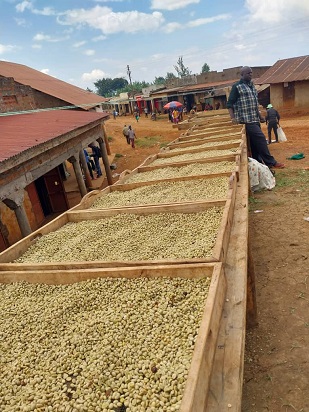


Varieties of cereals on sale at one of the stores in Busia Main Market in Busia Municipality.
Varieties of cereals on sale at one of the stores in Busia Main Market in Busia Municipality.
Small-scale cross-border traders in Busia Municipality have decried what they call unfair trade restrictions imposed by Kenyan authorities, accusing them of blocking access to cereal markets across the Busia-One Stop border point.
The traders alleged that while Kenyan traders freely market their agricultural produce in Uganda, their counterparts face constant barriers when attempting to sell cereals in Busia Market, Busia County in Kenya.
Mohamed Samanya Mwanje, a trader at Busia Main Market in Busia Municipality, told Uganda Radio Network in an interview that the continued restrictions have crippled trade and reduced profits at the border markets. Mwanje expressed frustration over the unequal market environment at the two border points and called for an urgent intervention from the Ugandan authorities.
According to Mwanje, the unregulated influx of Kenyan traders into Busia Municipality with truckloads of cereals and other agricultural produce has created an oversupply, pushing down prices and leaving Ugandans with little to no profit.
Zuhu Mbatude Badru, the Chairperson of Busia Women’s Cross Border Cereal Traders Cooperative, acknowledges that Ugandan traders face harsher treatment while across the border compared to the hospitality their counterparts enjoy while in Uganda.
Badru, however, pointed out the quality and food safety challenges among the Ugandan traders, which she says are complicating the trade from both sides of the border. She emphasized the need for sensitization among the small-scale traders on safe handling practices of cereals, packaging, and stringent enforcement of standards of produce exported to enable the traders to access the regional markets.
Richard Barasa, the Chairperson of Busia Produce Dealers Multi-Purpose Cooperative Society, noted that the challenge in cross-border trade has been further affected by the influx of Kenyan Middlemen who go deep in Ugandan villages to buy cereals. Barasa said the move is greatly affecting the Ugandan traders who sometimes fail to bulk cereals.
“These people go to villages and sometimes to farms and book the cereals from farmers before harvest. Whatever they purchase from here is taken to Kenyan markets, sometimes sold here, or taken for processing and later returned to Ugandan markets expensively,” said Barasa. He noted that the majority of traders who had been occupying Busia Main Market have since abandoned trade, leaving several stalls empty.
Speaking at a recent multi-stakeholder meeting on Intra-East African Community (EAC) Trade in Agro-ecology in Bugiri District, Hakim Baliraine, the Board Chairperson at ESSAF, called on the East African governments to respect the EAC trade protocols.
“We have the East African Commodity Market Protocol that provides for free movement of goods, labour, and persons. But the question is, is this being implemented? If small-scale farmers cannot trade freely across borders, then we are defeating the very essence of regional integration,” said Baliraine.
Baliraine added that while Uganda has invested in cross-border markets, citing the recently launched construction of the 41 billion shillings Elegu Cross Border market, gaps in fair access, quality assurance, and value addition continue to undermine small-scale traders. He, however, emphasized that quality and food safety must remain at the heart of the regional trade.
“As farmers who are food producers, you should know that quality is the assurance of better prices and put health first before selling any produce or product,” he said. Richard Maholo Koko, the Chairperson Cross Border Traders Association and secretary of the Kenyan Long-Distance Truck Drivers and Allied Union however, refuted the claims of trade restriction on Ugandan traders by Kenyan Authorities.
Koko told our reporter in an interview that nearly 80 percent of small-scale cross border traders from Uganda carry out trading across the Busia-one stop border inside Kenya weekly on Monday and Thursday.
According to him, under the Simplified Trade Regime, Ugandan small-scale traders can conduct business within a radius of 10 km inside Kenyan territory through a simplified process of clearing their goods and payment of nominal fee.
Uganda remains one of Kenya’s biggest trading partners in East African Community (EAC) and the leading destination of the country’s exports. According to the 2024 Uganda Bureau of Statistics Report, the country earned 72.5 million US Dollars in revenue exports to Kenya accounting for 10.4 percent of total export earnings in EAC.
According to the International Trade Centre Calculations, maize stood out as the most traded conventional product from Uganda to Kenya in 2023, as 211,642 tons were exported, fetching 59,141,000 million US Dollars.
-URN