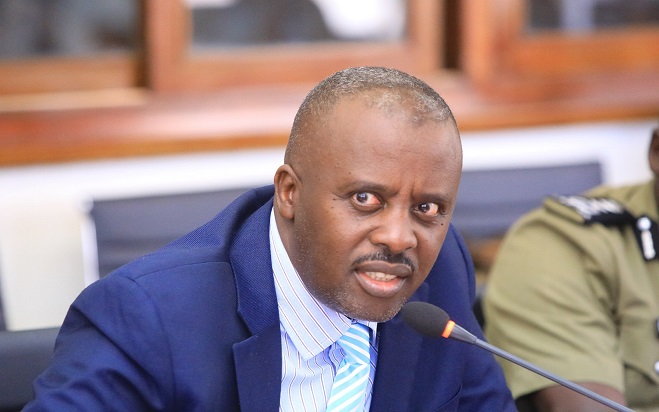

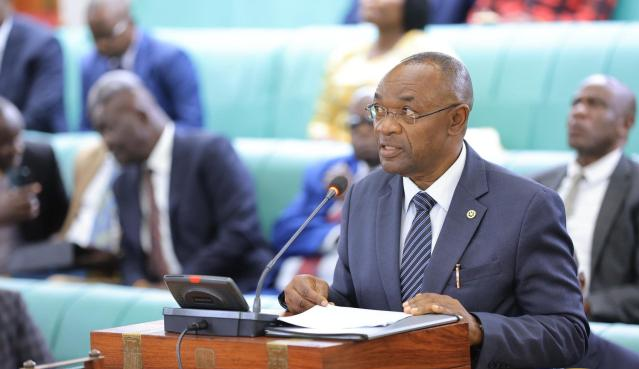
Minister of Local Government, Raphael Magyezi
Geoffrey Ekanya, the Tororo MP who tried to commit suicide on the floor of parliament by strangulation, can now look forward to a long life for the frustration that was tempting him to end his life. It has been erased by the NRM. Ekanya was driven into frustration after Tororo wasn’t declared a city ten years ago, tempting him take his own life, but was saved by intervention of other MPs who physically restrained him from accomplishing the crime that in any case would make him liable to penalties including two year’s imprisonment if the DPP pursued the matter.
The decision has broken the freeze on creating new administrative units that cost the taxpayer colossal sums of money in the name of taking services nearer to the people.
A new city creates high cost political posts like a new seat in parliament for a Woman MP, a team of city councilors, directors, and a Resident City Commissioner.
At a high-stakes ruling National Resistance Movement – NRM caucus meeting in State House, Entebbe, lawmakers endorsed splitting Tororo District into Mukuju, Mulanda, and Kisoko Districts while raising Tororo Municipality to Tororo City.
In a parallel move, Bundibugyo District will be split to form Bughendera District, to take services closer to isolated mountain communities and ease long-simmering ethnic tensions among the Bakonzo, Bamba, and Buisi, which recently claimed three lives.
Government Chief Whip Hamson Obua and Local Government Minister Raphael Magyezi broke the news to journalists at Parliament shortly after the caucus deliberations.
Uganda, already with 12 cities and 146 districts, is now set for a phased further administrative fragmentation with Tororo’s ‘promotion’ and Bundibugyo’s split in the 2025/2026 financial year, with more to follow up to 2031. Obua stressed that this is all “subject to the law”.
With the 2026 elections looming, journalists pressed Magyezi on whether the move amounted to manipulation of voters, but the Minister dismissed the claims, citing “the 2020 split of Nakawa Division that gave both seats to opposition”.
“We are doing this for service delivery, peace, and efficient administration. When people express their will through council resolutions, our duty is to act. The Constitution empowers us to respond to that will.”
Operationalizing the new districts will require UGX 26 billion, Magyezi revealed. Acknowledging concerns about a bloated wage bill, he argued the benefits outweigh the costs. “Yes, there is a burden, but Uganda’s population is growing fast. Urbanization is at 5.3% annually, the highest in Africa. People need services close to them, not far away. This process is lawful, technical, and democratic,” he said.
The Electoral Commission and Attorney General Kiwanuka Kiryowa will determine when elections in the new constituencies are held. Under the Local Governments Act, districts created after a general election take effect six months before the next one, which may mean backdating to July 2025.
Currently, Tororo has one Woman MP and a Municipal MP. Under the new arrangement, each of the three districts will gain its own Woman MP, while the city will have a Woman MP and two Division MPs, an expansion likely to increase Parliament’s size. For the feuding Itesot and Japadhola communities, the split is framed as a peace move.
Tororo City will serve as the shared hub and headquarters, preserving a name dear to both groups while granting them separate governance structures. In Bundibugyo, the creation of Bughendera District aims to curb recurring ethnic clashes in the highlands.
The caucus also used the meeting to congratulate President Yoweri Museveni on his unopposed endorsement as NRM National Chairperson and 2026 presidential flagbearer, receive an audit of the party’s membership register, and commit to fighting electoral “pollutants” such as vote-buying, rigging, and extortion. “We are determined to rid our politics of these cancers and support wealth creation instead,” Obua declared.
Tororo leaders had lobbied for years to be included in earlier rounds of district creation. During the 10th Parliament, MPs Fox Odoi, Oboth Oboth, and Sanjay Tana decried Tororo’s exclusion.
Odoi, voicing nearly two decades of frustration, lamented: “For 20 years, the government promised us another district. We remained sidelined.” Their persistence appears to have paid off. What once felt like neglect has now turned into elevation.
As Uganda redraws its administrative map, the strategy is clear: that division can yield unity, costs can breed service, and a once-despairing MP’s renewed smile can signal hope for communities long denied. Yet, with elections ahead, the ultimate question remains, will new lines on paper translate into better lives on the ground?
-URN