

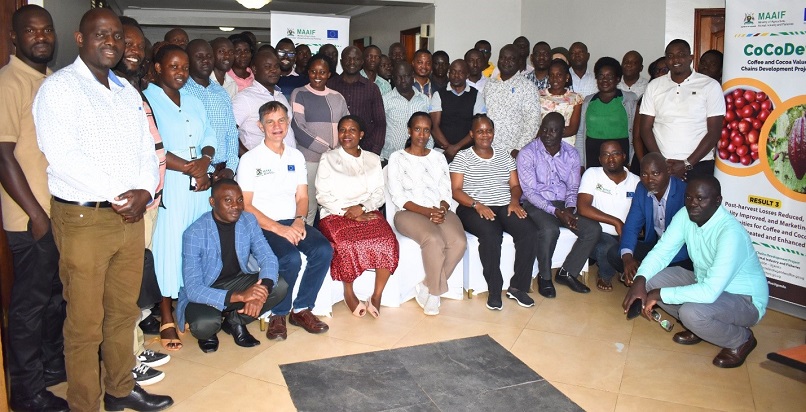
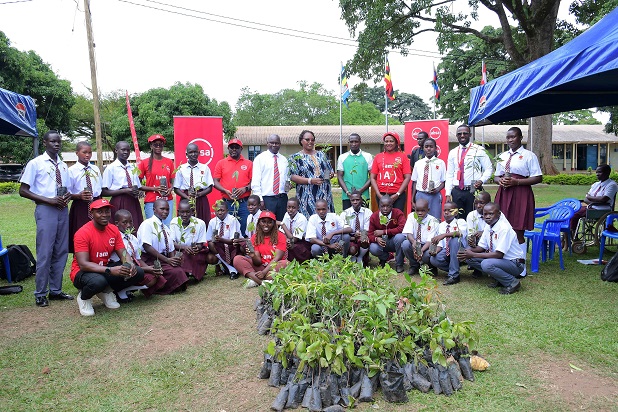
Participants at the CoCoDev sustainability training in Mbale
Participants at the CoCoDev sustainability training in Mbale
As Uganda’s coffee and cocoa exports surge, sustainable production, value addition and access to premium markets, remain key priorities to increase competitiveness and farmer earnings.
One way to achieve this is to increase the amount of sustainable and certified Ugandan coffee and cocoa on the global scene. This is because sustainability is no longer a choice but a necessity in coffee and cocoa production. Uganda’s producers need to adapt sustainable practices to remain competitive.
However, while the benefits of certification are immense, uptake by coffee and cocoa farmers remains low due to knowledge and skills gaps.
Increasing Uganda’s certified coffee and cocoa in global markets
Out of the 7.77 million coffee bags, worth US$ 2.22 billion, exported in financial year 2023/24, the percentage of certified coffees remained low. The case is similar with cocoa, which saw significant export increases over the last two years, with earnings rising by 88.2%, from an average of $72.8 million to $620.43 million.
The Government of Uganda, with support from the European Union, under The Coffee and Cocoa Value Chains Development Project (CoCoDev), are now putting in place mechanisms to increase certified Ugandan coffee and cocoa exports. CoCoDev has supported the development of a certification guide to empower small scale holder farmers to undertake this critical process.
CoCoDev, under the Ministry of Agriculture, Animal Industry and Fisheries (MAAIF), has organized a 5-day training on certification standards targeting government and private sector extension officers, drawn from across central, northern and eastern Uganda. The training targets 80 extension workers from MAAIF and private sector companies such as Kyagalanyi, Bugisu Cooperative Union, Masha Coffee and KAWACOM, amongst others, on use of the guide.
The training will enable participants to acquire the knowledge and skills required to support coffee and cocoa farmers to acquire sustainable certification.
After the training, the extension workers will use the knowledge and skills acquired to support farmers in getting certified under certification schemes of choice, and guide them on how to comply with the standards. The certification standards used as core examples for the training were: Organic, Fairtrade and Rain Forest Alliance. The Mbale training follows a similar training held in Mbarara for Eastern and Southern based extension agents, such that there will be 160 new resource people, able to support all processes towards sustainable certification, in any part of Uganda.
From volumes to sustainability
Speaking at the opening ceremony at Hill Top Hotel, Mbale City on Monday 18th August 2025, Eunice Kabibi, Assistant Commissioner, Coffee Department, MAAIF, noted that while government has put in place various policies to increase coffee production and exports, volumes alone will not guarantee market.
“We have the coffee Roadmap, Vision 2040, and the National Development Plan. We have so many targets that lead us to increasing the volumes of both coffee and cocoa. But volumes alone will not be able to achieve us the market.”
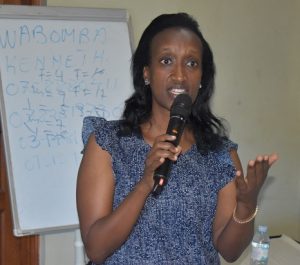
Ms Kabibi added that Uganda is in a dynamic global world and the markets have their demands, which the country must meet to ensure market is guaranteed for the increased coffee and cocoa volumes being produced.
“It is those demands that we must comply with, or follow, to be able to market our product, whether it is coffee or cocoa. We must also meet the growing demand for sustainability, among other demands. Sustainably produced and certified coffee and cocoa are growing in demand, so smallholder farmer certification is key,” Ms Kabibi noted.
She thanked the European Union for supporting the development of the coffee and cocoa smallholder farmer certification guide. She also extended appreciation to development partners, the European Union for their generous support through the GreenUp program, and CoCoDev, which is enabling this critical work.
Sandra Kamenya, Acting National Project Coordinator, noted that CoCoDev is a Government of Uganda project and is implemented through the Ministry of Agriculture, Animal Industry and Fisheries, with funding from the European Union.
“As we know, coffee in Uganda is gaining more and more international markets. But we need to be market ready and follow some of the global trends, which will increase value and market access of Ugandan coffee and cocoa. That is why CoCoDev, with the support of the technical advisory team, contracted a consultant to develop a Sustainable Certification Guide, which can be used to train the public and private extension workers,” stated Ms Kamenya.
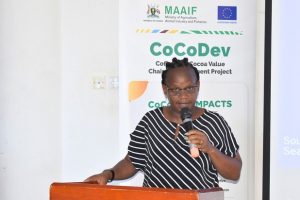
“We are here to equip extension agents so that you will become trainers of trainees and you will go out there to empower and instruct other extension officers, village agents, cooperative leaders, and coffee and cocoa farmers nationwide. So, that is why you’re here, so that you can be equipped and then you go and help those people to adapt to certification schemes,” Ms. Kamenya said.
Supporting coffee, cocoa to thrive
Overall, the CoCoDev project aims to assist Uganda in increasing jobs and income through supporting production and export of coffee and cocoa.
This project has three result areas. The first one is policy and regulation where it works with Uganda National Bureau of Standards (UNBS) to review and support the establishment of coffee standards.
The second result area of productivity focuses on research. CoCoDev is working with the National Coffee Research Institute (NaCORI) to multiply seedlings. These will be distributed to the nursery operators for upscaling, and then they will give them to the farmers. NaCORI is multiplying K8, 9 and 10, types, which have currently limited supply, but high demand, on the market.
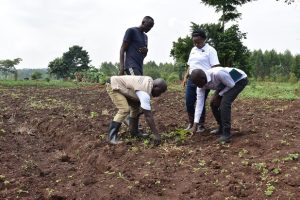
“We are trying to increase those three lines through NaCORI and there is support that we are giving them. At the same time, NaCORI is conducting research to adapt new coffee varieties into new non-traditional coffee areas,” Ms. Kamenya said.
CoCoDev’s contribution towards 20 million coffee bags production target
In line with the Presidential directive to increase coffee production to 20 million bags by 2030, CoCoDev is supporting researchers at NaCORI to see that new non-traditional coffee growing regions are getting varieties that are adapted to their areas. NaCORI is conducting trials of new varieties in West Nile, the cattle corridor districts and in Southwestern, in Kabale and Kisoro, to see coffee is adapted in those areas.
Result area 3 deals with post harvest handling and marketing. This result area considers post harvest quality, value addition and improved market access. And that is the area where the sustainable certification falls.
According to Alastair Taylor, Chief Technical Advisor, CoCoDev, there is an aspect of value addition in the project design.
“One way to add value, besides processing your coffee or cocoa, is to add sustainable certification, whether it is organic, Fairtrade or Rainforest Alliance,” Mr. Taylor noted.
Uganda’s coffee production has jumped to nearly 9 million bags up from 3.5 bags in 2017. Given the growing volumes, Gordorn Katwirenabo, the Assistant Commissioner in charge of quality at the Coffee Department in Ministry of Agriculture highlighted three major issues to be addressed to maintain the momentum towards the 20 million bags production target.
According to Mr. Katwirenabo, the key concerns amidst the rising volumes are how to keep coffee farms producing for future generations, how to attract premiums and generate more money for the producers and how to tackle the issue of climate change.
“We all know that currently, we can’t grow Arabica coffee in some areas that used to have Arabica coffee because of changes in the climate. You all know that currently, we are getting almost 70% less than we could have gotten in our coffee. Thirdly, almost over 30% of our losses are happening because we can’t manage on farm and off farm activities,” Mr. Katwirenabo said.
All this can be tackled through moving towards sustainable certification and MAAIF is behind you in these efforts.
“At the end of this training, we want to have partners that will drive sustainability along the value chain. The way we produce, the way we farm and the way we act. We want partners in ensuring that our coffee can attract premium prices by getting some of these sustainable standards.
But also we want to be sure that we can be ambassadors out there because I know your theories that will actually drive the love and also the urge, the drive to reduce losses along the value chain.
He closed the day by linking value additions to Presidential directive to add value and a concern about the overuse of Glyphosate across the country and a plea to minimise its use.
About the certification guide
The Coffee and Cocoa Smallholder Framer Certification Guide is an essential resource to support the adoption of sustainable production in Uganda’s coffee and cocoa sectors.
The Guide seeks to bridge existing knowledge, and technical gaps, in our value chains, providing a unified and critical reference manual for public and private extension officers. These officers are the crucial change agents who will guide farmers to establish an Internal Management System (IMS), with the IMS being the base requirement for meeting standards, under the major certification schemes such as Fairtrade, Organic and Rainforest Alliance.


As a coffee farmer and a processer in Uganda how can I get certificatifed in the coffee
Thank to support farmer and it’s going to increase the production of Qantity and quality coffee and coooa