


Some of the participants at the sustainable certification and standards training
Despite the benefits of sustainable certification of coffee and cocoa production, the number of farmers in Uganda who are certified and sell certified coffee and cocoa remains low. Less than 12% of Uganda’s total coffee exports are certified in regard to sustainability.
This means that many of the 1.8 million coffee farmers are missing out on the benefits of sustainable certification, in regard to economic, social and environmental benefits. This is a missed opportunity for Ugandan coffee and cocoa producers, who are already producing their crops using sustainable techniques, often described as “Climate Smart” or “Green” production methods.
The problem is compounded by lack of knowledge and a shortage of skilled persons to support farmers to acquire certifications.
The opportunity for sustainably certified coffee and cocoa
To reverse the fortunes of farmers, the Coffee and Cocoa Value Chains Development Project (CoCoDev), under the Ministry of Agriculture, Animal Industry and Fisheries (MAAIF), has organized a 5-day training in Mbarara. The workshop is equipping government and private sector extension workers, from across western Uganda, with the knowledge and skills required to enable them to support coffee and cocoa farmers to acquire sustainable certification. Ultimately, this will support an increase in farmer earnings, while enhancing environmental protection. The training covers various certification schemes, with the main focus being on; Fair Trade, Rainforest Alliance, and Organic.
After the training, the extension workers will use the knowledge and skills acquired to support farmers in getting certified under certification schemes of choice, and guide them on how to comply with the standards. By the end of the training it is expected that there will be 80 new resource persons in the country, who are able to support all processes towards sustainable certification.
Speaking at the opening ceremony at Oxford Hotel, Mbarara City on Monday, Sandra Kamenya, Acting National Project Coordinator, noted that CoCoDev, with support from the EU, has an objective to support Ugandans to increase rural jobs and incomes, through supporting increased production and export of coffee and cocoa.
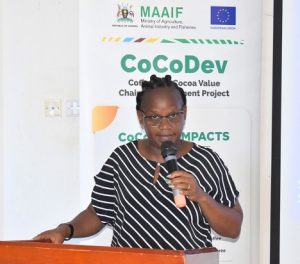
“CoCoDev contracted a consultant with support from the Technical Advisory Team of the EU, to develop a Sustainable Certification Guide to be used to train the public and the private extension workers,” Ms. Kamenya noted.
“The guide was developed by a Sustainable Certification expert, Florence Nagawa. After it was reviewed and approved by a technical team experienced in the sustainable sector, it was agreed that the guide was ready for use to train trainers.”
CoCoDev empowers extension workers to roll out certification
According to Ms. Kamenya, CoCoDev is now rolling out training sessions, which will draw in participants from across Uganda. The trainings will equip extension workers with knowledge and skills, to bridge the knowledge gap, which is a key hindrance to certification.
The first group of beneficiaries are extension workers from western Uganda.
“This workshop has brought together around 80 Trainers of Trainers (TOTs). Today, we are giving you knowledge on how to support farmers acquire sustainable certification in coffee and cocoa. Our trainers will provide you with knowledge on key sustainable certification schemes, namely; Fair Trade, Organic, and Rainforest Alliance certification.
The acting CoCoDev Coordinator warmly welcomed participants to the trainers of trainers (ToTs) workshop. “We wish you to be empowered to train other extension officers, village agents, cooperative leaders and coffee and cocoa farmers nationwide to adapt to the certification schemes.” Ms Kamenya added.
According to Alastair Taylor, the Chief Technical Advisor at CoCoDev, the sustainable certification training is implemented under Result area three of CoCoDev. Result 3 looks at post-harvest handling, value addition, improved market access and harnessing the sustainable certification opportunity, to enhance farmer incomes.
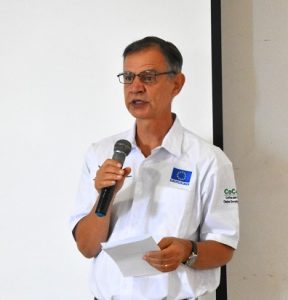
Mr Taylor stated to workshop participants “We are able to bring in specialists into the project to look into issues of sustainable certification. The reason you are here today, as a trainer of trainer (ToT), from the private or government sectors, is to build your capacity. Please interact with the facilitators and the other participants so you use your acquired knowledge to support your extension work at the forefront of coffee and cocoa promotion.”
Harnessing the benefits of certification
Rauben Keimusya, the Assistant Commissioner, Department of Coffee Production and Development, MAAIF, thanked the EU and the CoCoDev PMU team for organizing the workshop and supporting the government in the drive to ensure increased uptake of sustainable certification schemes in the coffee and cocoa sector.
“In Uganda, when it comes to coffee and cocoa, we know that by default 45% of our coffees are organic. But how much of our coffee do we sell as Organic, Fair Trade, or Rainforest Certified?”
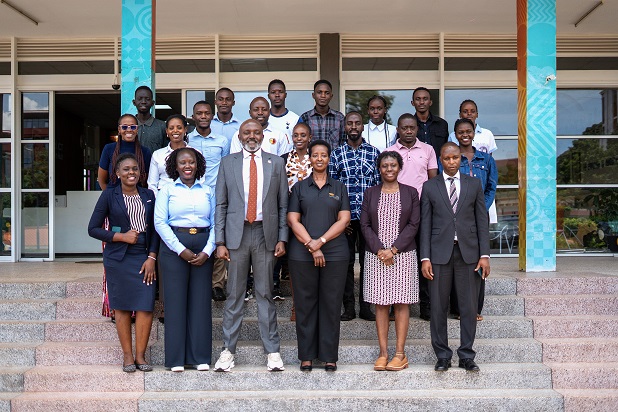
Participants at the CoCoDEV training in Mbarara
According to Mr. Keimusya, Uganda exports only 1% of its Robusta as organically certified, and for Arabica, the figure is 5%. He added that when you combine Uganda’s total exports certified under the various certification schemes, the number comes to 12%.

“This means we are above the global average of 8% so we are doing better in this sense, but this is still not enough,” Mr. Keimusya added.
Mr. Keimusya continued, “If you sell your coffee as organic certified, you earn a premium above the prevailing market price. For example, the price of coffee right now is at UGX 11,000, but if your coffee is organic or fair trade certified, a farmer gets an additional payment, which is called a premium. In Uganda, we are lucky that most of our farmers are still practicing organic farming”.
“Most of us observe fairness in the treatment of workers in the way we grow our products, especially coffee and cocoa, but we lack knowledge, which will be addressed within this workshop,” he observed.
Mr. Keimusya called on the extension workers to support farmers in acquiring sustainable certification because it brings enormous benefits.
Addressing the knowledge gap among extension workers
Mr. Keimusya, however, noted that, “One of the challenges the sector faces is that extension workers lack the knowledge to guide farmers on how they can apply for these certifications”.
“I therefore thank CoCoDev and the EU Delegation in Uganda for supporting us to acquire this knowledge so that we can extend this information to the farmers and the cooperatives, such that they can benefit from these incentives and premium prices.” Mr. Keimusya said.
“The second challenge we face in certification in Uganda is the cost of certification. Those who are aware that organic coffee is traded at a higher price than ordinary, or conventional, coffees, still cannot afford the cost of certification. And in Uganda, we have few companies that can do the certification audit.” He added.
“As agricultural experts, we all qualify to be auditors of these schemes. So, I invite you to attend the training to the end so that you are able to join the pool of experts and support the reduction in the costs relating to sustainable certification.
He noted that certification costs are very high because there are very few people who have the knowledge to undertake the certification audits, or who can know what it takes, and hence support farmers in undertaking the process.
“The demand for certified products is growing at a rate that we cannot keep up with. Land is not expanding, so farmers have to produce what they can sell very expensively so that we can earn value and have a decent living,” Mr. Keimusya emphasized.
Each Certification has specific requirements
According to Mr. Godfrey Lutwama, the training Consultant, the essence of sustainable certification is to enable farmers to produce a unique product away from the conventional coffees, which helps to negotiate better payments.
“This is business, and each certification standard, has its specific benefits and its specific requirements. The benefits accrued are specific to the certification adopted. In Fair Trade, there is a social component that pays a social premium to support community development projects or interventions. In organic, there is a component of not using synthetic chemicals. In the Rainforest Alliance, the environmental component is the most emphasized,” stated Mr. Godfrey Lutwama.
Sustainable Certification of Coffee or Cocoa is a form of value addition. It does not require hardware investment, but rather soft investment, through the establishment of the Internal Management System (IMS), on which the 3rd party auditors of the sustainable certification standards, base their assessments. MAAIF, through CoCoDev, with EU support, is building capacity of frontline field staff, but further investment support will be required to enable more producers to gain Sustainable Certification.
The next training in Sustainable Certification is planned in Mbale to attract extension workers from across Eastern Uganda.


Thanks for the training but we need this trainings also in all regions mostly in Bugisu region where I come from so that our farmers can benefit also because we also grow the crops you trained on, am khisa Antony from Namisindwa
Eagerly waiting for the certification trainings so that our farmers can benefit
We need such trainings everywhere all over the country, however bring such training to village or parish levels for us farming to learn and benefit more
I commend CoCoDev, EU and MAAIF for this initiative which I believe was long overdue. Equipping extension staff from both government and the private sector on sustainable certification is a big milestone in transforming the coffee and cocoa value chains especially in market diversification.
Over the years our Coffee farmers have suffered terrible drawbacks from acquiring knowledge from extension workers who have been ill-equiped on how to innovatively partner with farmers in the villages in areas that grow coffee.
It my sincere hope that this time round Maaif is serious with this issue.
The capacity building component of Cocodev project has come at a time when the country Uganda needs it most especially Cocoa value chain development which is still underdeveloped in the Country where farmers are constantly and eagerly seeking for government intervention in the promotion of the enterprise.