

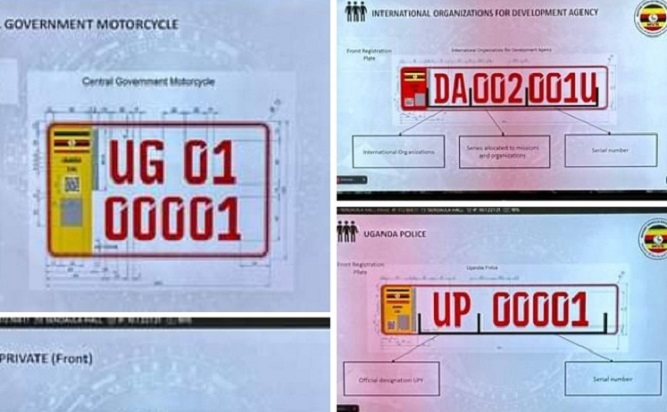
DIGITAL NUMBER-PLATES
Government contracted Joint Stock Company Global Security, a Russian firm to implement the 10-year digital number plate project
By Prisca Wanyenya
The Uganda GPS tracking and fleet management industry has accused Government of sidelining local firms in favour of Joint Stock Company Global Security, the Russian firm contracted to implement the 10-year digital number plate project, saying the 22 private players have lost 40% of their revenue to the contractor who never competed for the job.
The concern was raised by Anthony Mwandha, Secretary General of the GPS Telematics and IoT Association Limited (GTIAL), while appearing before Parliament’s Physical Infrastructure Committee on October 12, 2026.
Mwandha noted: “Most of us here have mortgaged private property to remain in this business. Typically, this business starts from Shs150,000 to maybe Shs300,000, our customers say, there is a government tracker in the system. So, they walk away from us and that affects our business, but when they go away, they still cannot see the government tracker. I also know that we register between 300-500 boda-bodas per day, for some of the people here that is the cake of their business. Now if you say that the boda-bodas which have been keeping many of these people in business, suddenly there is a regulation that they must pay a high cost tracker, then we fall off.”
Shaahid Jemani, a member of the Association, told the Committee that motorists signing up for digital number plates said to have security trackers are suffering and paying much higher costs without getting any benefit, yet private businesses have taken a hit.
Jemani explained: “The biggest impact we have seen is that once the players came into the market our business has absolutely gone down. I think my colleague was very humble in saying about 10%, it went down even further. There are a lot of briefcase companies that have come in which are not really regulated and not able to pay taxes, that was already affecting, it has affected more. The client’s point of view is very simple that if they are paying that kind of money for registration for the number plates and not getting visibility, it is something that is very painstaking.”
However, Mwine Mpaka, Chairperson of the Physical Infrastructure Committee, described the Association’s complaints about loss of business to Russians as hearsay, arguing that the private players failed to provide statistical data on how the government-backed player has affected their businesses.
Mwine said: “You need to give a better case, because you are saying they have taken you out of business, but I am still not convinced because I don’t have statistics. It could be true, I am not saying it is not true, but we need statistics. We are employing this number of Ugandans. So really, we need the facts. You can’t come here and just give us hearsay.”
Mwandha responded to concerns about half-baked data, saying his company had a turnover of just above US$1 million at its peak in 2022, but since the entry of the Russian players, it is now operating with capital of nearly US$50,000.
“In terms of loss of business directly by this company we have lost about, we project US$150,000 annual income loss. I know that the other people here have lost between seven and ten percent of their business. So if we are saying that 22 companies are supplying 2,000 trackers at 150,000 that is about nearly Shs3-6Bn, so if they have lost 10 percent, that means year-on-year these companies have lost US$300… if you take the average,” he noted.
Richard Sebamala (Bukoto Central) questioned GTIAL on their financial capacity to install digital number plates with trackers on vehicles in Uganda because the Russian company hired by Government committed to raise US$257 million for the project and the money would be recouped from trackers and number plates.
He asked: “As an association, did you have the capacity to mobilise those funds at that time? I don’t want us to have gone wrong when we had capacity, because I look at an association that has less than a million dollars. So now, that is what pushes us back to Joint Stock. As an association, what is your capacity? Because we can recommend that capacity, if it is US$5 million, be given to our local content. So as an association, you have not given us an insight on your capacity to do this work.”
Mwine however reminded fellow legislators that the focus of the probe shouldn’t be on who is running the digital number plate project, but rather how registration is done to boost security in Uganda.
“The system you are using is almost the same system the Russians are using, the challenge with the tracker is the same, yours can be removed, theirs can be removed. So, the question now should be the how, not who. This system of installing trackers in national cars, it is not anywhere in the world, even in Russia, they are using the ANPRs, in China, they are using an infrared windshield that sends a signal to the cameras,” he remarked.
The Chairperson also faulted players in the private sector for not ably making a case on losses they have suffered with entry of the Russian firm.
Mwine argued: “Even before you go to your capacity versus their capacity, is the how possible? Can we install trackers in every Ugandan’s car? Is it anywhere in the world? If not, why? I think we should concentrate on the how, not the who. Yes, you are Ugandans, but the problem we are trying to cure is not only the cost, but also security. Your tracker does not offer a sophisticated solution like theirs, because we have seen both trackers.”
Henry Isaiah Katongole, Chairperson of GTIAL, explained that tracking devices in Uganda currently operate in a way that when a vehicle passes through a road, infrared light is supposed to shine onto the vehicle, the shutter takes an image, the processor captures it, the compute engine processes it and sends it to the processing centre.
He added that when the image is captured, at the same point, the GPS location of that stand, the camera is also captured and timestamped.
Katongole noted: “From our standpoint, this is the solution that should have been implemented. What we have been listening to from this committee is a number plate capture, at the same time a GPS track. Now, these are two complementary technologies. But licence plate recognition, automatic number licence plate recognition technology is the technology that is being used all over the world for what we are trying to look at.”
Katongole further explained that the industrial global shutter camera costs between US$2,500 and US$4,500, while the external pulse infrared probe which lights onto the number plate costs between US$500 and US$1,200. Additionally, the edge controller which processes with AI costs between US$2,000 and US$4,500, which translates to just one installation by the roadside of between US$5,000 to US$10,000.



