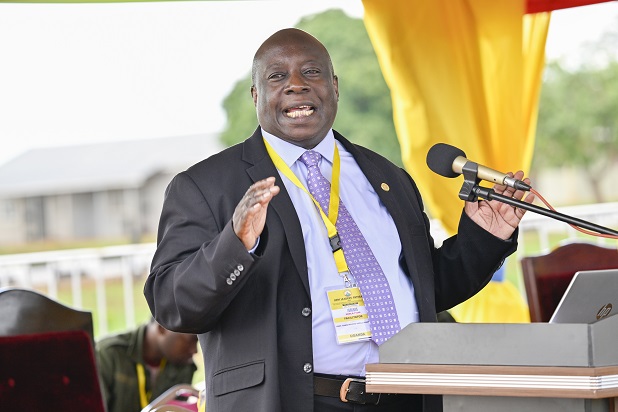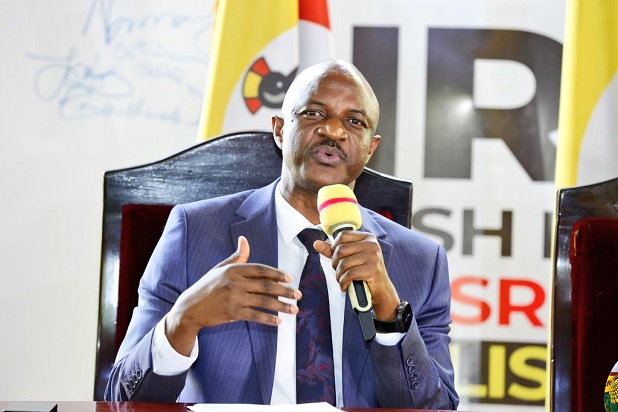

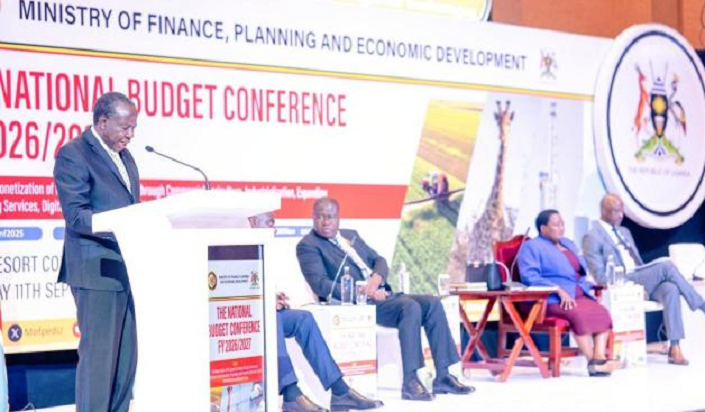
Minister Kasaija presenting the 2026-27 Budget Strategy at the Kampala International Conference Centre
Minister Kasaija presenting the 2026-27 Budget Strategy at the Kampala International Conference Centre
The government has announced the financing methods it hopes will be used to finance the next budget, featuring a mixture of sources of funding and their targeted application.
This will help the government balance between the need to finance the ambitious national plans, including the Budget, the fourth National Development Plan and the Tenfold Growth Strategy on one hand, and the increasingly scarce and expensive foreign financing on the other.
The Tenfold Growth Strategy will require mobilising significant resources, according to Matia Kasaija, Minister for Finance, Planning and Economic Development, while presenting the national Budget Strategy for the 2026/2027 financial year.
Kasaija says the government would continue borrowing from the international market, but that this will be based on the nature of the projects.
He says projects like expressways will be financed through Public Private Partnership, with concessional financing being borrowed mainly for non-financially viable but critical social services projects, while blended financing will go to infrastructure like electricity transmission, energy, the Standard Gauge railway, among others.
He says the Public-Private Partnership model of financing has not been as successful because of shortcomings in institutional arrangements. He, however, says that there is a plan to improve the delivery efficiency of the PPP project.
Non-external financed projects like district and community roads and other local government-implemented projects will largely depend on net domestic financing.
Kasaija says the government will continue borrowing from the commercial financial market, but that these loans will be used to fiancé projects that create direct monetary benefits.
He says that by doing this, it will help the government preserve the concessional loans strictly for non-commercial projects or projects meant for social services.
Kasaija says the financing of the Tenfold Growth Strategy will include reprioritisation of resources in the current fiscal framework or repurposing to increase allocative efficiency, implementing strategies to boost domestic revenue mobilisation, improving efficiency for the timely delivery of Public Private Partnership (PPP) projects and intensifying access to non-traditional innovative financing options.
Others are increasing Foreign Direct Investment (FDI) by maintaining sound fiscal and monetary policies to ensure macroeconomic stability and improve the country’s credit ratings, infrastructure development, reducing the cost of doing business, improving governance of government institutions, and the corporate sector.
Another strategy will involve leveraging affordable and sustainable financing through adequate capitalisation of Uganda Development Bank, Uganda Development Corporation (UDC), ACF, SBRF, and Emyooga, which attracts private capital and commercial bank financing in partnership with the Government.
The government also has plans to utilize the diaspora financing and infrastructure bonds to enhance the availability of resources. He explained that the government is drawing up the National Diaspora Policy to this end. Prime Minister Robinah Nabbanja stressed the need for total commitment to the efforts of lifting the 33 percent of the population from the subsistence economy to the money economy by working through Government wealth creation programs.
She said the budget strategy aims at deepening the implementation of the anchor growth sectors of the Agro-Industrialisation, Tourism Development, Mineral-Based Industrial Development, Science Technology and Innovation, including ICT and Creative Arts Industry (ATMS) and the Enablers.
She said there is a need to boost domestic revenue collection to achieve national targets and minimise borrowing both domestically and externally, which undermines the realisation of Uganda’s development.
Meanwhile, Minister Kasaija insisted that Uganda’s national debt, at UGX 116 trillion (USD 32.33 billion) as at the end of June 2025, having grown from UGX 94.72 trillion (USD 25.63 billion), remained sustainable.
Of this, he said domestic debt was UGX 60.34 trillion (USD16.8 billion), while external debt was UGX 55.88 trillion (USD 15.54 billion). This translates into a debt-to-GDP ratio of 51.3 percent, “remaining within sustainable thresholds in the short to medium term,” he says.
The Minister said the increase in public debt reflects higher external disbursements and expanded domestic borrowing to finance major infrastructure projects.
The share of domestic debt as a percentage of the total debt stock rose to 51.9 percent as at the end of June 2025, from 42.9 percent the previous year, which was within the approved medium-term debt strategy and annual borrowing plan of the ministry.
-URN