
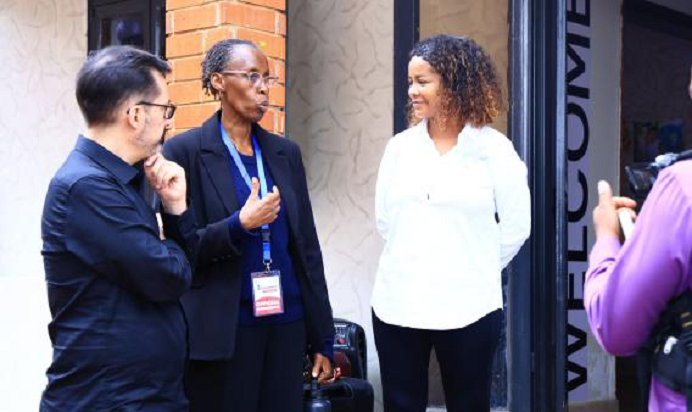
Prof. Chibita (middle) chatting with Kisanet Tedros (right), the CEO of Beles Bubu.
Prof. Chibita (middle) chatting with Kisanet Tedros (right), the CEO of Beles Bubu.
On a busy stretch along Gaba Road in Kampala, opposite Bunga Market, a small studio pulsates with music, laughter, and rehearsals of cultural dances. Inside, cameras roll as multilingual nursery rhymes are recorded, not just for entertainment, but for survival, identity, and belonging.
This is Beles BUBU Africa, a refugee-led cultural media project founded by Eritrean migrant Kisanet Tedros. It represents a growing story of how migrants in Uganda are carving out livelihoods while preserving heritage in a foreign land. The centre also addresses critical issues like domestic violence and youth literacy, while developing programs for women, refugees, and youth.
Six years ago, Tedros, together with her brother, launched the initiative to address what she calls a growing cultural identity crisis among migrant children, especially those born or raised far from their ancestral homes.
“Our goal is to teach children their language, culture, and heritage so they know where they come from,” she explains. “Many migrant children grow up disconnected from their roots. We want them to feel they belong somewhere.”
The project began with Tigrinya heritage content and has since produced over 1,300 educational videos, attracting more than 110 million views on YouTube alone.
Today, Beles BUBU Africa is expanding into languages including Amharic, Swahili, Luganda, Ateso, and Arabic, a deliberate effort to reach diverse African communities.
Beyond language preservation, the initiative is also a platform for integration. The production team includes Ugandans alongside migrants from Congo, Ethiopia, Somalia, and South Sudan. Tedros says peaceful coexistence is impossible without shared spaces.
“Integration is survival,” she says. “We work as one team because migrants cannot thrive in isolation.”
The studio doubles as an economic hub. Youth entrepreneurs, many of them refugees offer handmade crafts, food, and small services during productions and community events. Annual festivals organised by the group bring together families, artists, and businesses, offering rare moments of cultural pride and economic opportunity.
Yet behind the creativity lies a familiar migrant struggle: funding constraints, limited infrastructure, and the constant balancing act of survival. Tedros says the entire operation has grown organically, sustained by family effort and freelance partnerships.
“We’ve never had external funding,” she says. “But imagine what we could do with support, preserving endangered languages, documenting elders’ stories, and building world-class African children’s content.”
Her story mirrors a broader reality for many urban migrants in Uganda; one of adaptation, entrepreneurship, and informal support networks.
Uganda’s refugee policy is widely regarded as one of the most progressive in the world, allowing migrants to work, start businesses, and move freely.
According to Prof. Monica Chibita, a journalism scholar who has studied migration dynamics, this flexibility creates opportunities for skilled migrants to rebuild their lives.
“If someone arrives with a skill, Uganda’s framework allows them to earn a living,” she says. “Urban migrants often begin modestly, but over time they form networks and establish ventures that contribute to the economy.”
Still, survival is uneven. In refugee settlements, access to essential services remains a pressing challenge. Monica Kirungi, an assistant officer with the International Rescue Committee (IRC), says schools serving both host and refugee communities face staffing gaps and language barriers.
“Children learn best in familiar languages,” she explains. “But many teachers do not speak Swahili, Kinyarwanda, or other refugee languages, making education difficult for many migrants, especially in Kyaka.”
Healthcare systems in some settlements are similarly overstretched, with facilities struggling to accommodate growing populations. Youth skilling centres, once active, have slowed following the withdrawal of implementing partners, limiting pathways to employment.
Despite these gaps, migrants continue to demonstrate resilience. Many form cooperatives, small enterprises, and cultural networks that provide social protection and identity reinforcement.
For parents in the diaspora, projects like Beles BUBU Africa offer a lifeline, digital bridges connecting children to heritage while navigating life in a host country.
Yet public perception remains a hurdle. Some urban migrants report being viewed as economic competitors or social burdens. Prof. Chibita argues that such attitudes stem from limited understanding of migrants’ contributions.
“Migration stories are often told through a narrow lens,” she says. “When communities see migrants only as recipients of aid, they miss their economic and cultural value. Education including responsible media reporting is key to changing that narrative.”
As Uganda continues to host Africa’s largest migrant and refugee populations, stories like Beles BUBU Africa illustrate a powerful truth; survival is not merely about enduring hardship, it is about building through culture, entrepreneurship, and the human need to belong.
-URN