
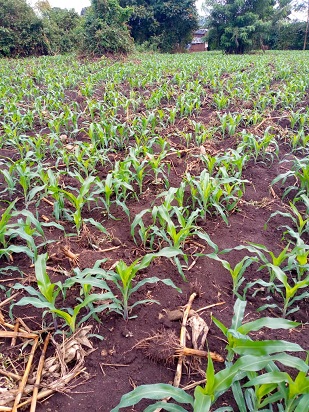
Kuta's maize for this season at three weeks
The September to December rainy season will be marked by limited and uneven rainfall patterns.
The Ministry of Water and Environment has cautioned that the September to December rainy season will be marked by limited and uneven rainfall patterns.
This is according to the September, October, November and December (SOND) season forecast released by the Department of Meteorological Services and signed off by Environment Minister Beatrice Atim Anywar.
The forecast noted that some areas projected to receive near-average to above-average rainfall will face poor distribution, while regions expecting near-average to below-average rainfall may not get enough to sustain normal socio-economic activities.
“…rainfall forecast indicates that several parts of the country are expected to receive near-average rainfall. However, some parts in the cattle corridor of the Southwestern region are expected to experience near-average, tending to below-average rainfall conditions during the forecast period,” the forecast document reads in part.
The forecast shows that most parts of the country will start receiving rain in mid-September. The peak is expected between late October and early November, with rains tapering off from mid to late December.
Yusuf Nsubuga, a senior meteorologist, noted that while all regions, including the western, central, and Lake Victoria basin areas, are projected to receive rains from mid-September, the onset may not be uniform.
“The report gives a range, but different regions may experience varying start times due to factors such as topography, wind patterns, and local temperature differences, among others. The expectation is that by mid-September, most of these regions will have started receiving some rains,” Nsubuga said.
According to the report, the seasonal rainfall will be influenced by the position of the rain belt over the country as the overhead sun shifts. Other factors include inter-seasonal variations in wind systems, the influence of the Congo air mass, topographical features, and the presence of large inland water bodies.
Meanwhile, for areas projected to receive near-average rainfall with a tendency toward below-average amounts, such as the western-central region covering districts like Luwero, Nakasongola, Mubende, Rakai, Kassanda, Kiboga, and Lyantonde, the Department of Meteorological Services issued an advisory warning of increased pests, disease outbreaks, water and pasture shortages, and water stress for crops such as coffee and bananas.
Farmers in these areas are urged to adopt measures such as irrigation, mulching, planting short-maturing crops, and water harvesting.
In contrast, the forecast is more favorable for the southwestern highland districts including Kabale, Kisoro, Rukungiri, Rubirizi, Bushenyi, Mitooma, and Rwampara, where near-average to above-average rainfall is expected.
These conditions are likely to boost crop production and result in optimal yields. Still, challenges such as soil erosion and waterlogging remain a concern. However, this excludes, the north, northwest, and sections of eastern Uganda around Mount Elgon which are currently in their rainy season which is expected to cession by mid to late November.
Florence Nakalema, a farmer in Lwengo, explained that many households in her area had expected the rains to arrive at the start of September and went ahead to plant crops. Weeks later, no rainfall has been received, leaving seedlings to wither and farmers anxious about the season ahead.
She said the community has grown increasingly uncertain about weather patterns, noting that what once were predictable seasons have now become unreliable. Florence fears this shift, which she attributes to climate change being felt across the country, will have a heavy toll on subsistence farmers who rely almost entirely on rainfall for survival.
-URN