
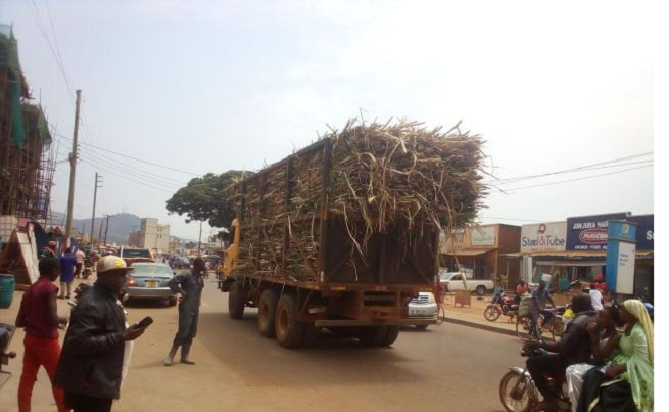
A truck with sugarcane / Courtesy photo
By Prisca Wanyenya
The Ministry of Trade, Industry and Cooperatives has issued stringent regulations to regulate Uganda’s sugar sector barring the establishment of sugar factories or mills next to each other, while for one to be registered as a sugar cane out grower, they must be in possession of not less than 1hectare of land on which to grow their cane and they will be required to sell their cane to specific sugar factories.
This follows the tabling of The Sugar Regulations, 2025 by Wilson Mbadi, Minister of State for Trade during the 20th October 2025 plenary sitting, which regulations are intended to operationalise The Sugar Act 2020, whose enactment witnessed a series of disagreements between Government and players in the sector.
In section 4 of the Sugar Regulations, Government has imposed conditions on how one can attain a licence to establish and operate mill stipulating that a person shall not establish or operate a sugar mill, jaggery mill or a plant to process the by-products of sugarcane without a valid licence granted for that purpose by the Minister but these provisions
However, in the new regulations, a licenses would not be granted where (a) the proposed mill or plant is to be situated in a place where there exists an established mill or plant and the surrounding land is not sufficient to produce enough sugarcane to support more than one mill or plant; or (b) the natural resources to support the mill or plant such as water are not sufficient to support more than one mill or plant on a sustainable basis.
The other conditions imposed against the granting of licenses is if (c) the mill to be established will adversely impact on the environment, the society, or the economic viability of the sugar industry in general; or (d) the person fails to provide an acceptable plan and undertaking on how the proposed mill or plant will develop new sources of sugarcane without affecting the existing sugar cane supply.
In Section 4(4) of the Sugar Regulations, before a licence is refused under subregulation (3)(a), the Minister shall ensure that the existing mill or plant is being operated efficiently and the miller has the capacity or is willing to provide the capacity to mill all the sugar cane which may be produced in the area.
The Ministry of Trade went further to demand in Section 13 (l) that a person granted a licence shall commence business within three years after the grant of the licence and where a person granted a licence does not commence business within three years after the grant of the licence, the Minister shall on the recommendation of the Council. revoke the licence.
The Ministry of Trade has imposed restriction on growing or selling sugar cane without registration by the Sugar Council stipulating in section 19 (l) where a person shall not grow or supply sugarcane to a person licensed or registered under these Regulations unless the person is registered with the Council and further in section 19 (2), a person licensed under these Regulations shall not procure or buy sugarcane from a person who is not registered by the Council.
For anyone who contravenes this particular regulation, they would be deemed to have committed an offence and shall. on conviction, be liable to a fine not exceeding two currency points (UGX40,000) or imprisonment not exceeding six months or both.
For the first time, Government is moving to register all sugar cane outgrowers in Uganda where the Ministry of Trade has provided in Section 22 (l) that a person shall not be eligible for registation as an outgrower unless (a) the person is already growing sugarcane at the time of application for registration or has ascertainable intentions to commence growing cane within a period of six months from the date of being registered.
The other condition is in Section 22(1)(b) where the person can be registered as an outgrower if he/she has been selling or supplying sugarcane to a sugar mill or plant and the name of the person appears in the records of the mill or plant.
The Ministry of Trade has also proposed that for one to be registered as a sugarcane outgrower, the area under sugarcane or area on which sugarcane is to be grown is not less than one hectare; and such a person should provide sufficient proof to the Council that he or she is able to transport and deliver sugarcane to the mill or plant.
In section 22 (2) Government has proposed to relax conditions for one to be registered as a sugar cane outgrower where the area for which the applicant wishes to register is less than one hectare, with the Sugar Council given powers to register the out grower provisionally for a period not exceeding three years to allow the outgrower grow one or more hectares of sugar cane to qualify for registration.
For instances where a person who applies for registration is a new outgrower or is a registered outgrower who wishes to expand his or her existing sugar cane growing area, the Council shall satisfy itself that (a) the existing mill or plant has capacity to mill the sugar cane to be Produced; and the land where the sugar cane is to be grown has been evaluated by an agricultural expert acceptable to the Council and deemed suitable for sugar cane cultivation on a sustainable basis.
Government has further imposed strict conditions on sugar cane outgrower registered by the Council where they will be required to supply all sugarcane produced to the miller or plant indicated in the register; maintain, at all times, the area of land specified in the certificate of registration under sugarcane; and not to expand or reduce the area under sugarcane without giving the concerned mill or plant and the Council at least twelve months’ notice of the intention to expand or reduce the area under sugarcane.
In section 32, the Ministry of Trade has proposed to bar the repackaging of consignment where a person shall not package sugar or by-products of sugar into a package of a different quantity, material or brand tom the original packaging without the approval of the Council, and where this is done, the packaging of an imported consignment, whether repackaged or in its original packaging, shall carry, in bold print, the name and contact details of the manufacturer, country of origin, and the vendor and purchaser, of the consignment.