
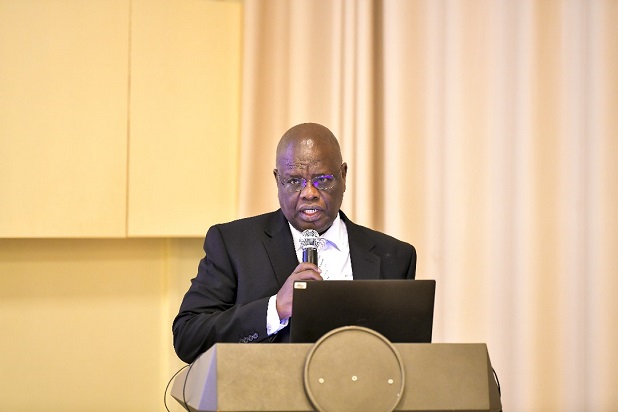
Fred K. Bamwesigye, the Director General at UCAA speaking at the workshop
Fred Bamwesigye, Director General at Uganda Civil Aviation Authority
The regional aviation industry has in recent months been dominated by disruptions in flights, including delays and cancellation, causing outcries amongst the traveling communities.
National flag carriers in the Eastern African Community: Uganda Airlines, Kenya Airways, Air Tanzania and Rwandair have not been spared the complaints lodged with different aviation bodies.
Fred Bamwesigye, Uganda Civil Aviation Authority Director General says there are global regulations and policies that govern the industry, which airlines must abide by.
“We must ensure safety, transparency and accountability, while creating environments where industries thrive, investments grow, and opportunities expand.”
And according to the COMESA (Common Market for East and Southern Africa) Competition Commission, there have been a growing number of complaints within the COMESA region from consumers, mainly since 2021.
Between 2021 and 2024, the CCC, handled more than 10 complaints involving different airlines and most of them were on a large scale, affecting several passengers within one complaint, bringing the total to 350.
The complaints related to frequent flight rescheduling, associated long delays and flight cancellations as well as challenging flight connections, leaving many consumers stranded and inconvenienced.
Others were increasing incidences of delayed flights, damaged or lost luggage; and failure by the Airlines to provide necessary support to affected passengers, including compensation, provision of accommodation or meals in case of prolonged delays or lack of guidance by the Airline to assist or follow up with passenger complaints.
Following the noticeably many complaints, the Committee launched a study to verify the claims and the redresses if any, taken by the airlines, and it revealed that there were possible violations of consumer rights.
Most common concerns were delayed flights which, which accounted for 31.71 percent, followed by rescheduled flights (15.43 percent), damaged baggage (11.71 percent), and delayed baggage (10.57 percent).
Cancelled flights accounted for 9.43 percent, while lost luggage and unfair booking conditions were 8 percent and overbooked flights 5.14 percent.
It was further noted that for the consumers that experienced a cancelled or delayed flight, 71.63 percent of the consumers did not receive redress from the airlines while 39.6 percent received redress in the form of a refund, meals, alternative booking or other means to their destination, accommodation and telephone services from the airline.
With regards to delayed, damaged or lost baggage, 72.34 percent of the affected consumers received information on where to submit baggage claims, compensation for loss or damage, compensation for incidentals or amenities, while 27.66 percent (39) did not receive the information.
“While airlines may not avoid occurrences that lead to complaints, it is important for them to have transparent dispute settlement mechanisms and ensure that the consumer concerns are addressed timely,” says CCC, adding that this helps mitigate distress and inconvenience to the consumer.
It also reminds the airlines that they are also bound by the provisions of the consumer protection laws at national as well as regional level depending on the nature of the complaint, and for COMESA, the consumer protection provisions contained in Part 5 of the COMESA Competition Regulations.
The Commission has now issued guidance in respect of the various complaints, to all airlines operating in the COMESA area.
Delayed Flights:
The guidelines provide that when an airline reasonably expects a flight to be delayed for between two and four hours beyond its scheduled time of departure, it should inform the passengers every 45 minutes of the earliest time they will be expecting to depart, the specific reasons for the delay.
Where the flight is supposed to last for less than three hours, it should inform passengers of their right to reschedule their flight without incurring any penalties and travel within an agreed period on the same route on a flight operated by the same airline.
The airline should also provide refreshments including water, soft drinks, confectionery or snacks, provide two international telephone calls, SMS or e-mails, and cause an announcement to be made at their airport of arrival of the new estimated time of arrival.
Should the delay be expected to last four hours or more, the airline should in addition to the above, provide a meal and hotel accommodation and supply transport between the airport and place of accommodation.
When the airline’s reasonably expected time of departure is at least six hours after the time of departure previously announced, the airline should inform the passengers of their right to immediate reimbursement of the full cost of the ticket at the price at which it was bought, for the part or parts of the journey not made if the flight is no longer serving any purpose in relation to the passenger’s original travel plan, together with, when relevant, a return flight to the first point of departure, at the earliest opportunity.
The airline also has the option to re-route the passenger, under comparable transport conditions, to their final destination at the earliest opportunity; or re-route the passenger, under comparable transport conditions, to their final destination at a later date at the passenger’s convenience, subject to availability of seats.
Where a passenger opts to reschedule a flight, the airline should assure itself of the availability of seats on the flight the passenger is requesting.
When an airline offers a passenger a flight to an airport alternative to that for which the booking was made, the operating air carrier should bear the cost of transferring the passenger from that alternative airport either to that for which the booking was made, or to another close-by destination agreed with the passenger.
Cancelled Flights:
There are instances where the decision to cancel the flight is taken less than 24 hours before the scheduled departure of the flight in question, or where the passenger on a connecting flight may have begun the earlier part of their flight before the decision to cancel the flight and may only know of the cancellation on arrival at the airport.
In this case, the airline is expected to inform the passengers of the specific reasons for the cancellation and inform them of their rights under this provision including the right to cancel their booking, the right to be re-routed or offered an alternative means of transport, where convenient to the passenger, and the right to compensation.
The passenger also has a right to refreshments and snacks, and two international telephone calls, SMS or e-mails.
“Where the decision to cancel is taken at least 24 hours before the flight the airline shall immediately contact the affected passengers, offer them the option not to travel to the airport if they have not already set off and advise them of their rights under this provision,” the guidelines say.
The rights include canceling their booking, being re-routed or offered an alternative means of transport, where convenient to the passenger in question, and compensation.
The announcement should be followed by an explanation on possible alternative transport like travel on the same airline but on a different date or time, travel on another airline from the same airport on a different date or time, and travel on another mode of transport, where reasonable and convenient to the passenger.
Passengers also have the right to compensation for a cancelled flight, unless they are informed of the cancellation seven to 14 days before the scheduled departure time and are offered re-routing, allowing them to depart no more than two hours before the scheduled time of departure and to reach their final destination less than four hours after the scheduled time of arrival.
The Airline can also avoid compensating if passengers are informed of the cancellation less than seven days before the scheduled departure and are offered re-routing, allowing them to depart no more than one hour before the scheduled time and to reach their final destination less than two hours after schedule.
Overbooking
In the event of overbooking, if a passenger who is unable to board as a consequence thereof, they shall have a right to a full refund and maybe entitled to compensation as the case maybe.
Delayed, lost or damaged baggage
Airlines are required to take measures as outlined in the Montreal Convention regarding delayed, lost or damaged baggage.
An airline carrying the baggage is liable in case of destruction, loss, damage or delay up to 1000 Special Drawing Rights (SDR) for each passenger.
Currently, an SDR equals to about UGX 5,000. The exception is when the passenger has made, at the time when the checked baggage was handed over to the carrier, a special declaration of interest in delivery at destination and has paid a supplementary sum if the case so requires.
In that case the carrier will be liable to pay a sum not exceeding the declared sum, unless it proves that the sum is greater than the passenger’s actual interest in delivery at destination.
Right to Reimbursement
In the case of reimbursement in the said cases, this should be effected within 30 days for the full cost of the ticket at the price at which it was bought for the part or parts of the journey not made, or for the part or parts already made if the flight is no longer serving any purpose in relation to the passenger’s original travel plan, together with, when relevant, a return flight to the first point of departure, at the earliest opportunity.
The guide provides for the reimbursement to be paid in the form in which the ticket or tour package was purchased.
Re-Routing
Where an airline decides to re-route a passenger, the passenger should be entitled to reimbursement within 30 days of the full cost of the ticket at the price at which it was bought, for the part or parts of the journey not made, and for the part or parts already made if the flight is no longer serving any purpose in relation to the passenger’s original plan.
Where a town, city or region is served by several airports, and an airline offers a passenger a flight to an alternative airport, the airline should bear the cost of transferring the passenger from that alternative airport either to that for which the booking was made, or to a nearby destination agreed upon.
Right to Compensation:
In relation to compensation, Article 18 of Annex 6 of the Yamoussoukro Declaration provides for compensation that passengers are entitled to in different circumstances, and airlines are airlines are guided to follow the provisions.
In the case where such compensation is not provided in the Warsaw Convention or Montreal Convention, passengers should receive compensation amounting to USD 250 (UGX 875,600 in current rates) for all flights with an estimated duration of three hours or less for the entire flight.
For all flights with an estimated duration between three hours and six hours for the entire flight, the rate is USD 400, and USD 600 for all flights with an estimated duration of more than six hours for the entire flight.
In determining the duration of the flight, the basis should be the last destination at which the denial of boarding or cancellation will delay the passenger’s arrival after the scheduled time and should include all scheduled stopovers, transit or any other scheduled break in the flight.
-URN