
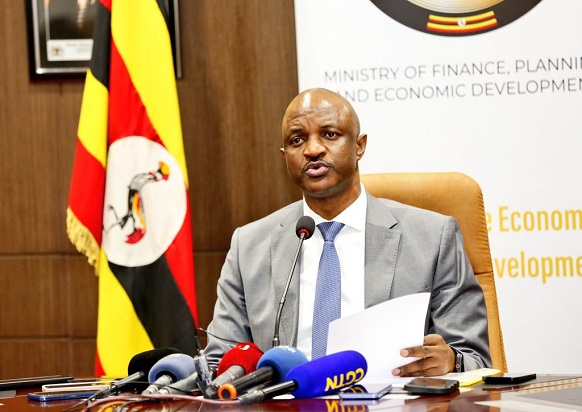
PSST Ggoobi assured the country of economic stability after elections
The Ministry of Finance has assured the country that the current economic stability will be maintained throughout the election period, despite increased spending by the government, political parties, and individual candidates.
The government has increased expenditure through the main budget and supplementary budgets to meet election-related commitments.
As a result, some Ugandans expressed concern that election-related spending could trigger higher inflation and put pressure on the foreign exchange rate.
Recently, the Governor of the Bank of Uganda, Michael Atingi-Ego, explained that increased spending during elections does not necessarily affect inflation, as long as the money being spent is not newly printed by the central bank. He noted that if the funds were already circulating in the economy, additional spending would not distort macroeconomic stability.
Speaking at the release of the third-quarter budget allocations on Friday, the Permanent Secretary and Secretary to the Treasury, Ramathan Ggoobi, said he understands public concerns about possible macroeconomic shocks, but stressed that past elections have shown Uganda’s ability to manage such periods.
He said that from the 2021 elections to date, Uganda’s inflation and exchange rates have remained more stable than in many countries globally, largely due to coordinated policy actions between the Ministry of Finance and the Bank of Uganda.
Uganda’s inflation has remained within the government’s five per cent target, averaging about 3.5 per cent over the past few years, a performance that compares favourably with many African countries. This stability has mainly been attributed to sustained food production, which has helped keep prices low.
“Our ability to maintain stable inflation lies in the government’s strategic investment in food production, effective monetary policy that has kept the shilling stable against major currencies, and the decision to directly import fuel through UNOC, all of which have helped stabilise prices,” Ggoobi said.
Ggoobi added that the Uganda Shilling is currently among the most stable currencies globally, alongside the British pound sterling and the Hong Kong dollar.
The government also points to various wealth creation programmes, including the Parish Development Model and Emyooga, noting that about 11 trillion Shillings has so far been invested under these initiatives. According to Ggoobi, increased production has been accompanied by rising tourism inflows and foreign direct investment, even as election campaigns intensify.
Tourism earnings have grown to 1.52 billion dollars (about 5.6 trillion Shillings) in 2025. Ggoobi attributed this growth largely to the return of Uganda Airlines, which has reduced regional travel costs by nearly half.
He noted that this trend is unusual, as elections in many countries often discourage tourists and investors. Combined with increased exports, the tourism growth has helped keep the Shilling strong against major currencies, including the US dollar.
The third-quarter releases totalled 16.5 trillion Shillings, with 510 billion Shillings allocated to security and presidency-related agencies. The Ministry of Defence and Veteran Affairs received 270.05 billion Shillings, the Uganda Police Force 42.12 billion Shillings, and the State House 17.92 billion Shillings.
The Uganda Prisons Service received 73.04 billion Shillings, the Office of the President 45.68 billion Shillings, and the Internal Security Organisation (ISO) 42.92 billion Shillings.
Meanwhile, security agencies, including the police and the UPDF, have warned that any attempts to cause violence or disrupt the electoral process will not be tolerated. A breakdown of the allocations shows that external financing, mainly loan-funded spending, accounted for 3.2 trillion Shillings. Wage allocations stood at 2.175 trillion Shillings, while non-wage expenditures amounted to 2.898 trillion Shillings.
Government development programmes received 514 billion Shillings, treasury operations were allocated 7.6 trillion Shillings, and local revenue mobilisation efforts received 82 billion Shillings.
-URN
About the Author