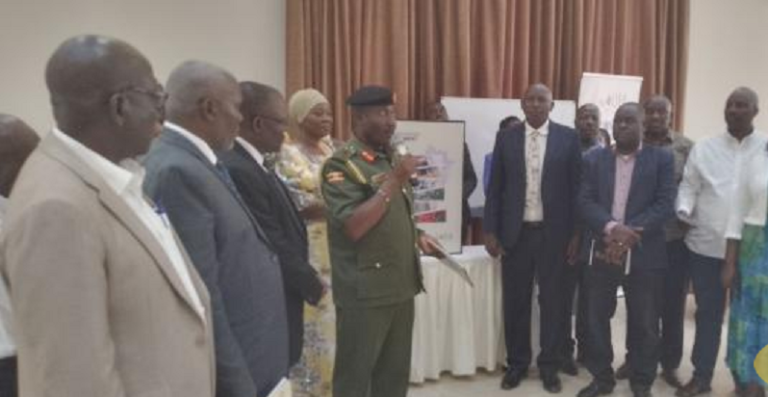

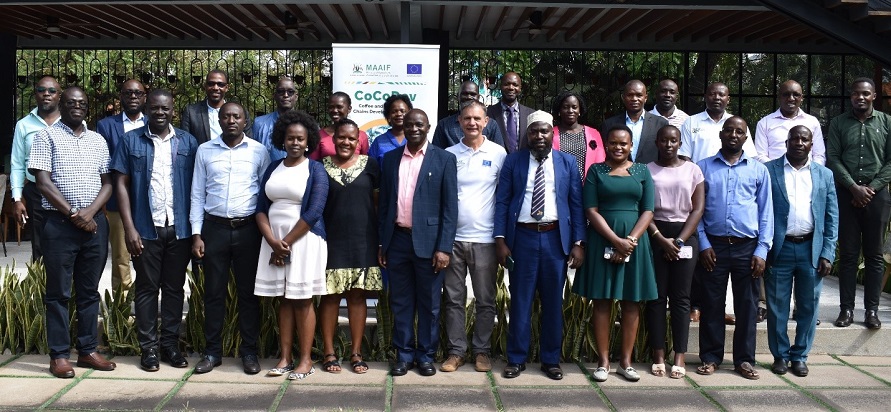
Coffee and cocoa experts at the Post Harvest Handling (PHH) validation workshop organized by CoCoDev at Fairway Hotel, Kampala
Coffee and cocoa experts at the Post Harvest Handling (PHH) validation workshop organized by CoCoDev at Fairway Hotel, Kampala
Post-Harvest Handling (PHH) practices are the thin line between poverty and prosperity for coffee and cocoa farmers in Uganda.
The Coffee and Cocoa Value Chains Development Project (CoCoDev), with support from the Government of Uganda and European Union, is developing two post-harvest manuals, one for coffee and another for cocoa.
These manuals will equip public and private extension workers to ensure that farmers are provided with consistent PHH messages. The information presented within the manuals, and the knowledge and skills building which can be developed from them, will help to counter the high post-harvest losses which occur in the coffee and cocoa value chains – which often amount to over 30%!
The manuals will support value chain actors to improve current practices, such as; harvesting, drying, fermentation, storage, and processing, and thus enabling improved market access, and better prices.
Speaking at the validation workshop for the two manuals on 9th December 2025 at the Fairway Hotel, Kampala, Ronald Kasozi, the Project Coordinator, CoCoDev, noted that the manuals provide a comprehensive reference point for actors.
“The manuals highlight where the highest on-farm post-harvest losses occur, the cause, and how to mitigate them. The manuals show key post-harvest steps that a farmer needs to take to ensure quality. They also show both qualitative and quantitative losses a farmer can experience”, stated Mr. Kasozi
“To address these gaps, the Post-Harvest Handling Manual has been developed as a comprehensive, and yet practical reference for farmers, aggregators, processors, and extension personnel. They present the recommended practices for harvesting, fermentation, drying, sorting, storage, transportation, and compliance with relevant quality and safety standards,” Kasozi added.
He added: “These manuals are intended not only as a technical guide, but also as a practical tool that can be applied in daily operations to reduce losses and improve product quality. The results will be enhanced incomes, access to better markets, and better overall value chain performance.”
In his remarks, Dr. Gerald Kyalo, Commissioner, Coffee Department, Ministry of Agriculture, Animal Industry and Fisheries (MAAIF), thanked CoCoDev for developing the manuals. He noted that the PHH manuals captured post-harvest losses (PHL) in detail, something that had not been documented before.
“The new manuals are detailed enough, and they are going to help extension workers and policy makers to tackle the challenges faced by farmers and other players in the industry. The manuals will also be used by legislators to develop policies to regulate PHH practices,” Dr. Kyalo noted.
The manuals document the proper handling of coffee and cocoa produced and traded in Uganda for improved access to the highly competitive world market for these commodities.
The manuals are divided into 6 sections:
Section 1 introduces the manual, highlighting its purpose, justifying its importance, and who should use it.
Section 2 gives the background, including the role coffee/cocoa plays in improving the livelihoods of sector players and government revenue. It also explains what loss is and the three types of post-harvest losses, namely: quantitative, qualitative, and economic.
Section 3 shows a value chain map, showing the key channels through which coffee and cocoa are traded from farm to export, through to final roasting, and chocolate making. It also summarises post-harvest stages where quantitative and qualitative losses occur, and estimates the monetary costs linked to these losses.
Sections 4 outlines detailed recommended practices for harvest, post-harvest handling, and quality control, to ensure production of high-quality beans at the farm level, maintain quality throughout the entire value chain, and prepare for local and export markets.
Section 5 focuses on value addition to coffee and cocoa, waste management during post-harvest handling, and promoting a circular economy to boost earnings from coffee and cocoa production.
Section 6 lists strategies that can be employed by the government, and other value chain actors, to ensure sustainable production of quality coffee and cocoa.
The two manuals – A Technical Manual for Control and Management of Post-Harvest Losses in Cocoa in Uganda and A Technical Manual for Control and Management of Post-Harvest Losses in Coffee in Uganda were compiled by Mr. Joseph Mulindwa and Prof. Archileo N. Kaaya.

Speaking at the workshop, Mulindwa noted that one of the unique aspects of the manuals is that the researchers have translated the losses arising from poor post-handling practices into monetary terms.
A farmer loses between 25%-30% as a result of poor post-harvest practices. The loss in monetary terms is equivalent to UGX 4,200 per 1kg of FAQ. 1kg of FAQ is UGX 14,000.
Mulindwa explained that farmers experience three types of post-harvest losses. Quantitative loss arising from loss in saleable weight of coffee or cocoa beans. Qualitative loss associated with a reduction in fitness or superiority, or excellence of beans and economic loss is associated with the monetary value of the product.
“The responsibility to reduce this loss is several-fold. It is a positive step to see MAAIF, through the EU-funded CoCoDev project, develop these manuals, which will be used by extension workers to train farmers to adopt better practices,” Mulindwa said.
The manuals will be released to the public in early 2026, after approval by the Technical Team at MAAIF.
By Alfred Rwamirego