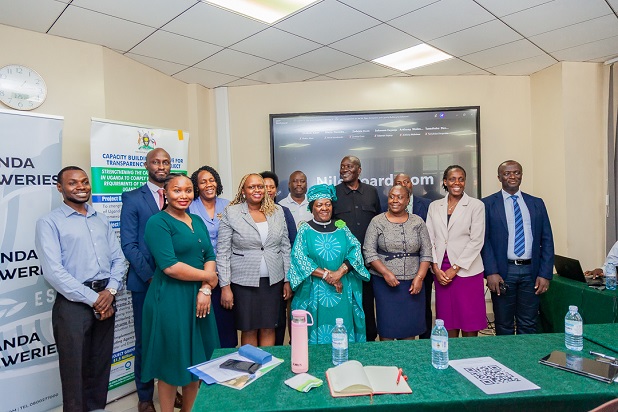

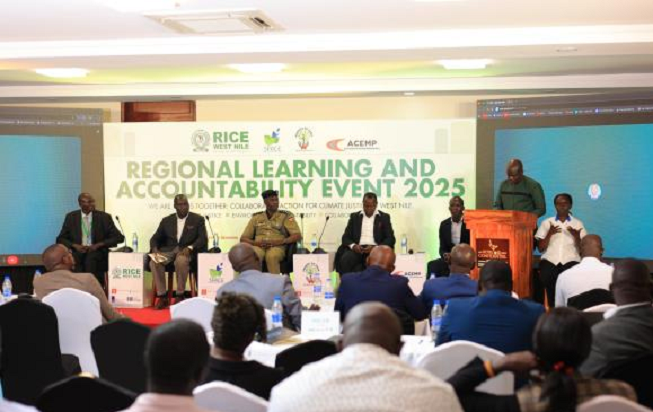
Officials from different sectors appearing in a panel of discussion during the regional learning and accountability event
Officials from different sectors appearing in a panel of discussion during the regional learning and accountability event
Leaders and environmental activists in West Nile have expressed disappointment over the failure or laxity by security agencies to enforce the Presidential directive that prohibited charcoal burning and trade.
President Yoweri Museveni’s Executive Order No. 3 of 2023 prohibited charcoal burning and trade in northern and northeastern Uganda, including Karamoja, Teso, Lango, Acholi, and West Nile. The aim was to combat rampant deforestation and promote sustainable energy alternatives.
President Museveni, in the executive order, noted that “one form of corruption is in the phenomenon of charcoal business,” pointing out that people in charge of environment and forestry allow the destructive business of charcoal to go on massively as armed people escort trucks carrying charcoal.
In West Nile, there is a concern that the executive order has not been strictly enforced by the police and other security agencies. It has been noted that the charcoal trade remains lucrative in West Nile as traders cut down trees from forests, like Zoka Central Forest Reserve. Most of the charcoal is ferried and sold in Kampala and neighboring towns in central Uganda.
Some West Nile leaders in West Nile attribute the continuity of the charcoal trade to the protection that the traders receive after trucks loaded with charcoal are impounded.
Obongi Resident District Commissioner, Samuel Mpimbaza Hashaka, narrated that his attempts to impound trucks loaded with charcoal landed him in problems after he was summoned by the police for obstruction.
The RDC made this revelation at a regional learning and accountability event convened by Rural Initiative for Community Empowerment (RICE) West Nile, which is spearheading the implementation of Strengthening Environmental Accountability and Climate Action in West Nile (SEA-WN). The project, which started last year, is funded by the Royal Danish Embassy, the Embassy of Ireland, the Kingdom of the Netherlands, and the Embassy of Sweden.
Simon Peter Aimai, the West Nile Regional Environment Protection Police Officer, said he will step up operations against charcoal burning and trade.
William Leslie Amanzuru, the Team Leader at Friends of Zoka, challenged stakeholders to play their roles diligently if environmental crimes are to be addressed in the region.
He said, the joint effort from different stakeholders will make it possible to have the problems easily identified, and equally, joint solutions will be provided.
Pax Sakari, the Executive Director of RICE West Nile, acknowledged challenges faced by leaders in addressing environmental problems.
The Strengthening Environmental Accountability and Climate Action in West Nile (SEA-WN) project aims at improving the sustainable use of natural resources in the West Nile region, in the districts of Zombo, Madi Okollo, Obongi, and Adjumani, with an expansion to Amudat and Nakapiripirit, which are facing environmental destruction.
In June 2025, the Economic Policy Research Centre (EPRC), in a paper, “Is Uganda Ready for a Ban on Use and Sale of Charcoal in Cities?” noted that there were operational challenges in enforcing the executive order.” While the government’s resolve to curb charcoal use is clear, several hurdles could impede a smooth transition to cleaner energy alternatives. A primary concern is the affordability and reliability of electricity and Liquefied Petroleum Gas (LPG) for many urban households.”
-URN