
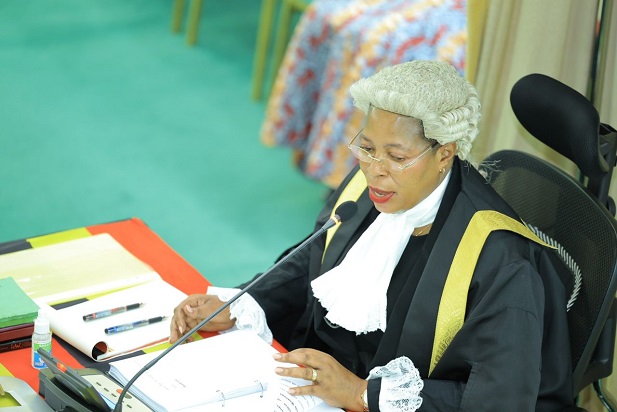
Speaker of Parliament Anita Among
In a political landscape long dominated by President Yoweri Museveni, a new figure is commanding unprecedented national attention-Speaker of Parliament Anita Annet Among.
On a whirlwind tour across Uganda, Among is not merely making promises; she’s delivering results, winning over teachers, civil servants, and voters alike, and, notably, converting members of the opposition to the ruling National Resistance Movement (NRM) party.
Among has recently been seen wooing Abdu Katuntu, the independent MP for Bugweri County and a former stalwart of the Forum for Democratic Change -FDC.
It is now plausible that the engagement is only becoming public, as it seems to have started long before when she served as his deputy on Parliament’s COSASE accountability committee that scored stunning results for the public and the taxpayers- where it now appears she was honing her skills for the future takeover of Parliament speakership, which materialised sooner than later with the untimely demise of Speaker Jacob Oulanya.
Her track record already includes facilitating defections of Martin Ojara Mapenduzi (Gulu City West), Anthony Akol (Kilak North), and Michael Lakony, LC5 Chairperson of Amuru District, to the ruling NRM party.
Her influence extends well beyond parliamentary corridors. Recently, she brokered peace with striking teachers and local government workers, ending a month-long industrial dispute over salary disparities, an issue that had long vexed the Executive.
“This is a people-centred Parliament that handles every grievance from across the country to the satisfaction of citizens,” Among declared after mediating the impasse.
According to Hassan Lwabayi Mudiba, Secretary-General of the Uganda Local Government Workers’ Union, the decision to petition the Speaker directly stemmed from the need for “urgent attention” to their concerns.
“Parliament was the ideal door to knock on for a quick and tangible response,” he said.
Her recent election as Second National Vice Chairperson of the NRM, replacing her predecessor Rebecca Kadaga, has solidified her position within the ruling party’s upper echelons.
Yet, her expanding reach, often into functions traditionally reserved for the Prime Minister’s Office, has sparked whispers in political circles: Is the real centre of power shifting from State House to Parliament?
Timothy Msobor Chemonges, the Executive Director of at the Centre for Policy Analysis -CEPA, argues that Among’s influence reflects a deliberate strategy to build political capital both within Parliament and the NRM.
“What makes her stand out is how she has converted her role as Speaker into a platform for direct engagement with citizens,” Chemonges said. “By resolving issues the Executive has struggled with, she’s earning trust beyond her office.”
However, he cautions that Among’s rise must be viewed within the Museveni political system, where power is “carefully managed.”
“Museveni has a history of empowering strong figures only to later reassert control when their influence grows too pronounced, so Among’s independence and longevity will depend on how she navigates that balance,” he added.
Eng. Tonny Olanya Olenge, a youth activist and former Northern Region coordinator for the National Unity Platform (NUP), describes Among’s leadership style as “executive-like.”
“Her approach, resolving industrial disputes, facilitating defections, delivering services, is far beyond the traditional oversight role of the legislature,” Olenge noted. “With her concurrent election as NRM Vice Chairperson, she now wields dual authority, institutional and political, giving her unprecedented leverage.”
He adds: “Among’s rise doesn’t necessarily weaken Museveni; it may be a calculated consolidation of future NRM power under a new, assertive leader.”
Sharon Adong, President of the Democratic Party’s Women League, believes Among’s strong mobilisation skills were honed during her time in the FDC. “She’s one of the most skillful women mobilisers in the NRM,” Adong said. “Museveni could be moulding her as Kadaga’s political replacement, a younger, bolder mobiliser with grassroots charm.”
Turyafuna Derrick, a lawyer and advocate for civic participation, argues that Among has redefined the Speakership in Uganda. “Unlike her predecessors, Edward Ssekandi, Rebecca Kadaga, and Late Jacob Oulanyah who confined their roles to parliamentary procedure, Among has taken the office nationwide,” Turyafuna said. “She resolves local disputes, delivers services, and even engineers political defections. The Speakership is now a national political platform.”
He further observes that the Speaker’s office budget has tripled under her tenure, enhancing her capacity to build networks and reward allies. “Money in Uganda’s politics isn’t just administrative; it’s leverage. It’s what has allowed her to expand her political reach across the country,” he asserted.
Still, Turyafuna warns: “History reminds us of figures like Bukenya, Mbabazi, and Kadaga who once seemed to be rising beyond the system, only to be reined in. The question is whether Among’s ascent is sanctioned or self-engineered.”
Among’s philanthropy and public generosity are cementing her popularity. As the rising cancer rates in Uganda affect almost every family, she has launched a USD4.3 million (UGX15billion) cancer patient’s home right inside Mulago National Referral Hospital’s Uganda Cance Institute to be funded by Friends of Annet Anita Among Foundation.
There has been rising outcry as patients from all over the country languish around Mulago as they await treatment at the strained facility, with many patients spending months around in deplorable unsheltered conditions as they cannot afford transport for numerous trips to and from Kampala.
Now Among has just gone ahead and offered the solution, which is bound to touch the hearts of whoever has (had) a cancer patient.
Her personal and political giving, from launching the Bukedea Teaching Hospital and Comprehensive School to donating a Range Rover Vogue to her husband, Moses Magogo, on his birthday has amplified her image as both wealthy and benevolent.
Her “corporate social responsibility” activities, reportedly funded through Parliament-linked accounts, have further boosted her visibility in Bukedea and beyond. President Museveni himself praised her for developments in Bukedea, though he reportedly questioned the source of funds for some of her projects.
These gestures, though politically effective, have also fueled public scrutiny and questions about accountability.
Among’s rise has not been without turbulence. In April 2024, the UK sanctioned her under its Global Anti-Corruption Regime, citing her alleged role in the diversion of iron sheets meant for impoverished Karamoja communities. A month later, the U.S. followed suit, accusing her of “significant corruption”.
She has denied wrongdoing, suggesting the sanctions this was politically motivated, retaliation, she claims, for her support of Uganda’s Anti-LGBTQ law.
Her leadership style has also drawn domestic criticism. In September 2023, court overturned Parliament’s suspension of MP Francis Zaake, citing violations of natural justice and quorum rules. In August 2024, MP Yorke Alioni accused Among of ignoring petitions over a UGX 1.7 billion “service award” scandal involving four Parliamentary Commissioners.
Her public remark in Lwengo, likening corruption to a “child who eats and brings home” drew condemnation from the Uganda Law Society for normalising theft of public funds.
Meanwhile, the social media campaign #UgandaParliamentExhibition has amplified allegations of extravagance and misuse of public money under her watch. Still, President Museveni has fiercely defended her, dismissing critics as “traitors working for foreigners.”
Among’s power today is both institutional and personal, anchored in her position as Speaker and her carefully cultivated networks. Yet, the same visibility that fuels her ascent exposes her to heightened scrutiny and political risk.
Analysts say she embodies the paradox of Uganda’s political system: a powerful actor operating within tight presidential control. Whether she becomes a lasting national force or the latest figure tamed by the system remains to be seen.
Her trajectory echoes that of John Patrick Amama Mbabazi, once Museveni’s trusted lieutenant who later fell out of favour. But unlike Mbabazi, Among’s power play is highly public and populist, rooted in visibility rather than secrecy.
As discontent brews within the NRM and among citizens, Speaker Anita Among stands at the centre of Uganda’s evolving power dynamic. Is Uganda witnessing the rise of a new political powerhouse, or merely another loyalist testing the limits of the Museveni era?
-URN
About the Author